Author: ericfishon

  • A Calm Coloring Corner for Little Orthodox Hearts: Meet Our Free Swamp Coloring Page

    A Calm Coloring Corner for Little Orthodox Hearts: Meet Our Free Swamp Coloring Page

    Some moments call for less noise, fewer instructions, and a little more room to breathe.

    After Divine Liturgy, during Sunday school, while waiting for a family member, or at home after a full day, children may need a gentle way to settle their bodies and reconnect with themselves. Coloring can offer that kind of pause. It gives little hands something meaningful to do while leaving room for quiet, imagination, and peaceful attention.

    That is why we created a free swamp coloring page for children and families:

    👉 Open the free Swamp Coloring Canvas

    This kid-friendly, screen-based activity works directly on a child’s device. No account is needed, and the coloring stays on that device. Children can choose colors, explore the scene, and begin again whenever they wish.

    It is simple by design, and sometimes simple is exactly what a child needs. 💛

    A Gentle Screen-Based Activity for Quiet Moments

    Our free coloring canvas features a friendly swamp scene waiting for each child’s imagination. Children might add green reeds, golden cattails, blue water, purple flowers, or colors that do not exist anywhere in nature at all.

    There is no “right” way to complete the page.

    A child may color carefully inside each shape. Another child may tap quickly, choose one favorite color, or leave parts of the picture untouched. A child may finish the entire scene, return to it later, or start over just to try a new idea.

    All of these choices are welcome.

    For families searching for calming activities for kids, digital coloring can be a practical option because it is:

    • Quiet and easy to begin
    • Available without gathering many supplies
    • Flexible for different attention spans
    • Enjoyable for children who prefer screens
    • Open-ended rather than performance-based
    • Simple to use during transitions or waiting times

    We can offer the invitation and then let the child lead.

    A peaceful activity does not ask a child to be different. It gives the child room to be fully themselves. ✨

    Why a Swamp Scene?

    A swamp is full of small wonders.

    There may be ripples in the water, frogs resting near the reeds, birds moving through the sky, insects buzzing above the surface, and plants growing in unexpected places. For children, a swamp coloring page can become an invitation to look closer at the natural world.

    In an Orthodox Christian home, this can gently open a conversation about creation without turning the activity into a lesson or test.

    Together, we might wonder:

    • What living things could God have placed in this wetland?
    • Which colors would we see in the morning?
    • Where might a frog rest?
    • What sounds could we hear if we paused beside the water?
    • How does creation show variety, movement, and beauty?

    There is no need to explain everything. We can simply pause, breathe, listen, and look closer.

    The swamp becomes a small doorway into gratitude.

    When we look closely at creation, we may discover another quiet reason to give thanks. 🌿

    Two children choosing flexible, sensory-friendly creative activities in a peaceful church corner

    Use It During or After Church, Without Pressure

    Church environments can hold great beauty, but they can also include bright lights, unfamiliar sounds, crowded spaces, long periods of waiting, and changes in routine. Some children may need movement. Others may need quiet. Some may want to participate through listening, while others connect best through drawing or color.

    A coloring activity does not mean a child is “not paying attention.” It may be one way the child remains regulated enough to stay connected to the community.

    You might offer the coloring canvas:

    Before church

    Use it as a gentle preview or transition activity. A few quiet minutes of coloring can help a child move from the pace of home into the rhythm of the parish.

    During a waiting period

    If your family is waiting before a service, meeting, or class, the canvas can provide a familiar activity with a clear beginning and no complicated setup.

    After Divine Liturgy

    Some children need time to decompress after worship. A calm coloring moment can help them move slowly from the church environment back into conversation, travel, or family time.

    During Sunday school

    Teachers and catechists can offer it as one choice within a flexible activity station. A child may color while listening to a story, take a quiet break, or join the group when ready.

    The goal is not to make every child participate in the same way. The goal is to make belonging possible in more than one way.

    A Simple Three-Step Calm Coloring Routine

    We can make the activity ready to use in just a few gentle steps.

    1. Notice

    Before offering the activity, notice what the child may be communicating through their body.

    Are they covering their ears? Moving quickly? Becoming quiet? Looking for an exit? Asking the same question repeatedly? Becoming tired after a busy service?

    We do not need to wait for distress to become intense. Early support is kind support.

    2. Prepare

    Open the free Swamp Coloring Canvas on the child’s device. Adjust the environment if helpful:

    • Lower the brightness
    • Offer headphones without requiring them
    • Sit in a quieter area
    • Provide a comfortable seat or movement option
    • Keep language short and warm
    • Let the child hold or position the device in a preferred way

    We can say, “Would you like to color, look, or take a quiet break?” Giving choices protects autonomy.

    3. Welcome

    Let the child decide how to participate.

    They may point, tap, speak, move, watch, or draw. They may enjoy a short visit with the activity and then stop. We can welcome the beginning, the middle, and the ending without asking for a finished product.

    A simple closing phrase might be:

    “Thank you for showing me your colors. You can come back to this whenever you want.”

    Participation can be gentle, flexible, and real. Every small connection matters. 🤍

    Support Faith Formation Through Choice

    Faith formation for kids does not have to look identical for every child.

    One child may enjoy memorizing prayers. Another may connect through icons, movement, music, stories, nature, or color. A sensory-friendly approach helps us widen the doorway so that more children can encounter the life of the Church with dignity and joy.

    The swamp canvas can sit alongside other Orthodox children activities, such as:

    • Looking at an icon and noticing colors or shapes
    • Listening to a short saint story
    • Naming something beautiful from creation
    • Saying a brief prayer of thanksgiving
    • Drawing a favorite part of Sunday school
    • Taking a movement break before returning to the group
    • Choosing whether to speak, point, or simply listen

    We can keep the spiritual invitation small:

    “While you color, you may think of something beautiful God has made.”

    Or:

    “Would you like to say, ‘Thank You, God, for the world around us’?”

    The child may say yes, no, not now, or nothing at all. The invitation remains loving even when the answer is no.

    A Ready-to-Use Idea for Parents and Teachers

    Here is a simple activity you can use at home or in a parish setting.

    Theme: God’s Beautiful Creation

    1. Open the free swamp coloring page.
    2. Invite the child to choose one color.
    3. Give them uninterrupted time to explore.
    4. If they are interested, talk about one animal or plant that might live near the water.
    5. End with a quiet breath, a short prayer, or a choice to continue independently.

    There is no worksheet to complete and no answer sheet to check.

    For younger children, we might simply sit nearby. For older children, we could invite them to create a story about the swamp. For children who communicate differently, we can offer picture choices, gestures, or yes-and-no questions.

    This is one small, concrete tool that families, Sunday school teachers, and parish leaders can use immediately.

    A welcoming Orthodox Christian community scene with children engaging in prayer, learning, and creative participation

    Screen Time Can Be Intentional and Connected

    Families often receive complicated messages about screens. We do not need to treat every digital activity as either perfect or harmful.

    A screen can be used in many ways. This coloring canvas is designed as a quiet, creative invitation: not as a replacement for relationship, worship, outdoor play, rest, or conversation.

    We can use it intentionally:

    • For a short transition
    • During a calm-down period
    • As part of a quiet church toolbox
    • Before or after a faith conversation
    • At home when physical supplies are unavailable
    • As an option for children who prefer digital creativity

    We can also observe what the child needs. If the screen is increasing frustration, we can pause. If the child is becoming peaceful and engaged, we can allow the activity to continue for a while.

    There is no single perfect routine. Together, we can notice, adjust, and try again.

    Bring a Little More Welcome to the Faith Community

    Inclusive Orthodox Christian parenting is not about creating pressure-free perfection. It is about continuing to ask, “What would help this child feel safe enough to belong?”

    Sometimes the answer is a visual schedule. Sometimes it is a movement break, a quiet seat, a familiar object, or permission to participate from the edge of the room.

    Sometimes it is a free swamp coloring page on a child’s own device.

    We hope this resource gives your family or parish one more practical way to make space for different bodies, different communication styles, and different ways of connecting with God’s beautiful world.

    👉 Try the free Swamp Coloring Canvas here

    For more sensory-aware and inclusive Orthodox Christian faith formation resources, visit XTERMIGATOR Kids Hellenic.

    Every child belongs. Every child brings beauty. And together, we can make our churches and homes gentler places to grow in faith. 🕊️

    Different is beautiful. Every child belongs. There is room for you here. 💛

  • How to Help Your Child Feel Ready for Sunday School This Fall

    How to Help Your Child Feel Ready for Sunday School This Fall

    🍂 September can bring a fresh beginning: new classrooms, new teachers, familiar prayers, and the joyful rhythm of returning to parish life. It can also bring uncertainty, especially for children who are sensory-sensitive, autistic, have ADHD, or communicate in ways that do not always fit traditional classroom expectations.

    If your child feels worried about Sunday school, you are not alone. And your child is not doing anything wrong.

    Readiness does not mean sitting perfectly still, answering every question aloud, or participating in every activity. Readiness can mean knowing what to expect, having a safe way to ask for help, and understanding that there is more than one beautiful way to belong.

    Together, we can make Sunday school a gentler, more welcoming experience through small, practical steps.

    Every child belongs. Every child is wonderfully made. Different is beautiful. 💛

    1. Notice What Helps Your Child Feel Safe

    Before we make a plan, let’s pause, breathe, listen, and look closer.

    Think about your child’s previous experiences with church, school, or group activities. What felt comfortable? What felt overwhelming? Were there particular sounds, smells, lights, transitions, or social expectations that made participation difficult?

    Sensory differences can vary from child to child and even from Sunday to Sunday. Some children may find chanting, crowded hallways, incense, bright lights, or sudden sounds difficult. Others may seek movement, touch, or extra activity to stay regulated. The National Autistic Society explains that autistic people may be more or less sensitive to sensory information, and these experiences can change depending on energy, stress, health, and environment. Learn more about sensory processing.

    You might gently note:

    • Sounds that feel too loud or unpredictable
    • Lighting, visual clutter, or crowded spaces
    • Clothing textures or strong scents
    • Waiting, transitions, or separation from a parent
    • Activities your child naturally enjoys
    • Early signs that your child needs a break
    • Calming tools or routines that already work at home

    This is not a test or a formal evaluation. It is simply a way to learn from your child’s lived experience.

    We do not need to change the child. We can change the path so the child can walk with us. 🌿

    2. Visit the Classroom Before the First Lesson

    A quiet preview can make a new setting feel more familiar.

    If possible, ask the teacher, catechist, or parish ministry leader whether you can visit the classroom before the Sunday school year begins. A short visit, perhaps ten minutes, is enough. Your child might:

    1. Walk from the entrance to the classroom.
    2. See where coats, bags, and supplies go.
    3. Look at the chairs, tables, icons, and activity areas.
    4. Find the restroom and a quiet place for breaks.
    5. Meet the teacher while the room is calm.
    6. Practice leaving and returning to the classroom.

    You can take a few photos, if permitted, and use them to create a simple “Sunday School Story” at home:

    We arrive → We find our classroom → We say hello → We look at the schedule → We listen or join an activity → We take a break if needed → We meet our family again.

    Avoid promising that everything will happen exactly the same way. Instead, use reassuring language such as, “This is what may happen, and we will have a plan if something changes.”

    For families seeking a broader parish partnership, our parish inclusion pathway offers practical ideas for mapping the church experience, preparing volunteers, and creating flexible ways to participate.

    A child experiencing sensory overload in church while receiving gentle, compassionate support

    3. Make the Day Predictable With Visual Supports

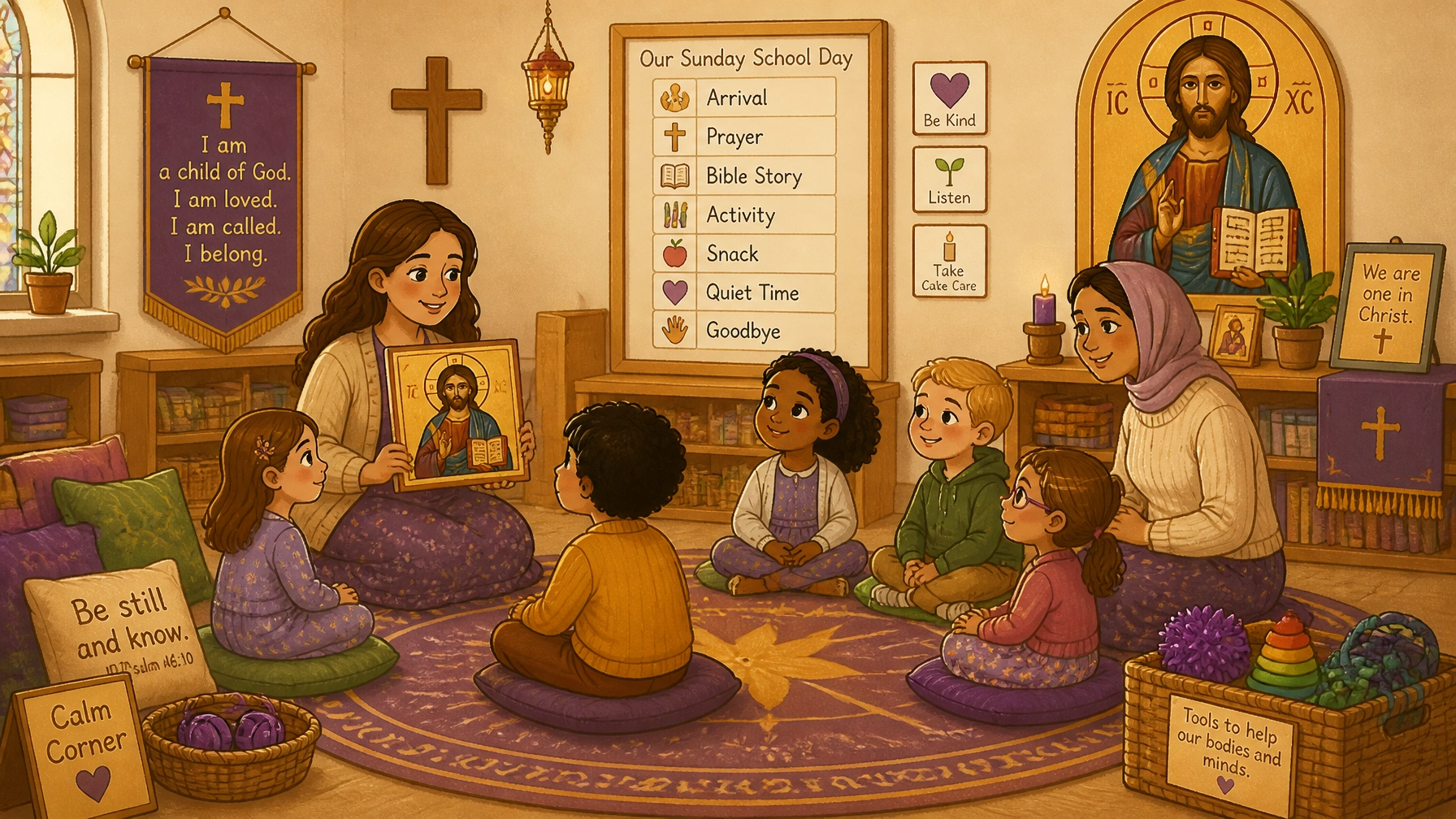
    Words alone can be difficult to process when a child is anxious or excited. A visual schedule gives the day a shape we can see.

    At home, try a simple schedule using drawings, printed pictures, photographs, or written words:

    • Wake up
    • Get dressed
    • Eat breakfast
    • Pack church bag
    • Drive to church
    • Sunday school
    • Divine Liturgy or family time
    • Snack
    • Go home
    • Quiet rest

    For younger children, use just three to five steps. For older children, add more detail if that feels helpful. Your child can point, move a symbol, check a box, or cross off each step.

    The classroom schedule might look like this:

    Welcome → Prayer → Story → Activity → Movement Break → Snack → Closing Prayer → Family

    A visual schedule is not a demand. It is an invitation and a source of information. If the order changes, show your child what is different. A “change” card or simple phrase such as “First story, then craft” can reduce uncertainty.

    You can also use a visual timer or give gentle transition warnings:

    • “Five minutes until cleanup.”
    • “Two more turns, then prayer.”
    • “First shoes, then car.”
    • “The music is starting. Headphones are available.”

    Our inclusive lesson planner is designed around multiple ways to see, hear, move with, and respond to a faith lesson.

    When we make the next step visible, we make room for peace. ✨

    4. Pack a Comfort Item and a Small Church Toolkit

    A familiar item can help connect home and church.

    Invite your child to choose one comfort item for the church bag. It might be a small stuffed animal, a soft cloth, a favorite pencil, a quiet fidget, or a small prayer card. The item does not need to be religious to be meaningful. Comfort and regulation are important parts of participation.

    Depending on your child’s preferences, the bag might include:

    • Child-sized headphones or ear defenders
    • A quiet fidget or soft object
    • A communication card
    • A small drawing pad and pencil
    • Water or a familiar snack, if permitted
    • A visual schedule
    • A “break” card
    • A comfort item

    If your child uses AAC, sign language, gestures, pictures, or a communication device, bring the system they already know. Church should not require a child to communicate in only one approved way.

    A resource such as My Quiet Church Toolbox can inspire families and parish teams to think about calm tools, prayer helpers, quiet hands, and flexible participation.

    Tools are not rewards for “good behavior.” They are supports that help children access the community.

    5. Plan Movement and Flexible Participation

    Many children, including children with ADHD, sensory differences, and communication differences, may learn and regulate better when movement is part of the plan.

    Before church, offer a gentle movement activity your child enjoys: stretching, walking, dancing, carrying a bag, jumping, or playing outside. Keep it playful rather than prescriptive. We are not trying to make a child tired enough to comply. We are helping their body arrive with support.

    During Sunday school, ask whether the teacher can include:

    • Stretching between activities
    • Standing or kneeling options
    • A job such as carrying books or supplies
    • Flexible seating
    • Doodling while listening
    • A short hallway or quiet-room break
    • The option to rejoin when ready

    Participation may look like speaking, pointing, watching, listening, drawing, building, moving, typing, signing, or praying quietly. A child may engage with a saint’s story by choosing a picture rather than answering aloud. They may show understanding through a craft instead of a worksheet.

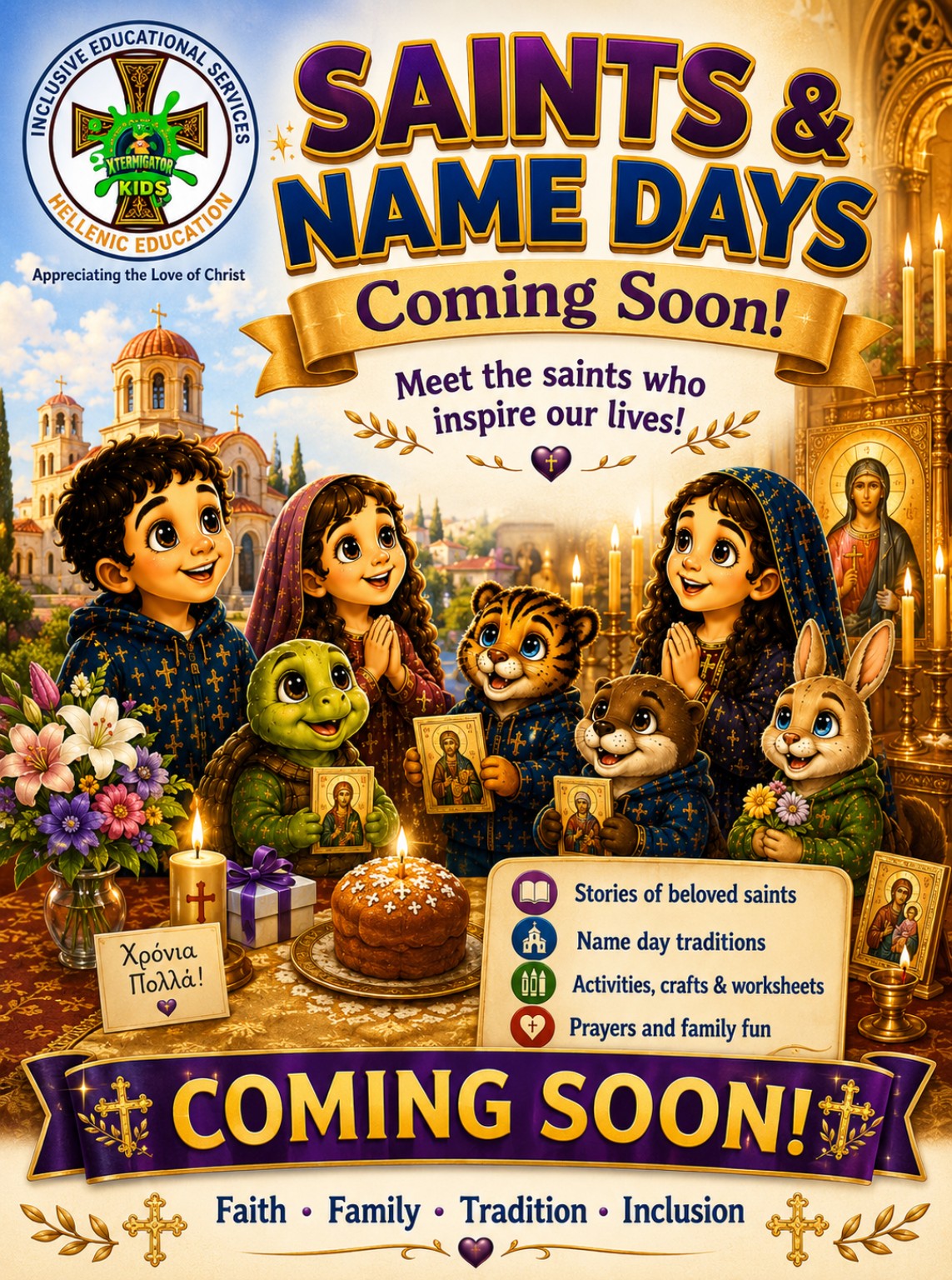
    Our Saints and Name Days activities offer options for reading, listening, pointing, drawing, writing, praying, and talking with a trusted adult.

    Orthodox children and families learning together through stories, prayer, and accessible activities

    6. Talk With the Teacher or Catechist

    A short, collaborative conversation can make a meaningful difference. You do not need to explain everything about your child. Share the information that will help the team welcome them well.

    You might say:

    “My child may need a little extra time to warm up. It helps when adults use short, clear directions and show what is happening next.”

    Or:

    “If the room becomes too loud, my child may cover their ears or stop speaking. Please allow a break without asking many questions. We will use this card to communicate.”

    Helpful topics include:

    • How your child communicates “help,” “finished,” or “break”
    • What sensory experiences may be difficult
    • What helps your child reconnect
    • Whether a trusted adult can be a consistent contact
    • Where your child can sit
    • How the teacher will respond if your child needs to leave
    • How and when the family should be contacted

    A healthy special needs church ministry does not wait for a child to struggle before making a plan. A strong neurodiverse church ministry welcomes family expertise, protects privacy, and makes accommodations ordinary rather than embarrassing.

    The National Autistic Society’s guidance on sensory adjustments includes quiet spaces, sensory tools, movement breaks, flexible seating, visual simplicity, and permission to use a break card. Many of these adjustments are inexpensive and can benefit the whole classroom.

    A Gentle First-Sunday Plan

    Here is a simple plan we can use together:

    1. Before leaving: Review the visual schedule and pack the church bag.
    2. On arrival: Come a few minutes early if possible.
    3. At the classroom: Show your child the schedule, seat, exit, and break space.
    4. During class: Offer choices without pressure.
    5. If overwhelm appears: Reduce words, lower stimulation, and allow space.
    6. Afterward: Provide quiet recovery time and notice what helped.

    A successful Sunday may mean staying for the whole lesson. It may also mean visiting the room, trying one activity, taking a break, or leaving early with dignity. Each of these can be a meaningful step.

    Orthodox faith formation is not measured by perfect stillness. It grows through relationship, repetition, love, and belonging.

    There is room for your child here. There is room for every way your child shines. 💜

    Frequently Asked Questions

    How can I help my autistic child prepare for Sunday school?

    Start with predictability and partnership. Visit the classroom ahead of time, use a visual schedule, pack familiar sensory supports, and talk with the catechist about communication and break needs.

    What should be included in an inclusive Sunday school curriculum?

    An inclusive Sunday school curriculum offers more than one way to learn and respond. Include stories, pictures, objects, movement, prayer, drawing, discussion, and choice-based activities so children can participate by speaking, pointing, moving, writing, or observing.

    Does sensory-friendly participation change Orthodox traditions?

    No. Sensory-friendly support does not make faith “less Orthodox.” It helps children understand, anticipate, regulate, communicate, and participate in the life of the Church while honoring Orthodox tradition.

    What if my child is not ready to stay for the whole class?

    That is okay. Begin with a short visit or one familiar activity. Progress can be gradual, flexible, and child-led. Your child’s belonging is not dependent on completing a lesson.

    For more practical resources for families, educators, and parish leaders, explore XTERMIGATOR Kids Hellenic.

  • How to Create a Sensory-Friendly Sunday School Curriculum in 5 Minutes

    How to Create a Sensory-Friendly Sunday School Curriculum in 5 Minutes

    Welcome, dear friends, catechists, and fellow pilgrims on this beautiful journey of faith! 💛

    If you have ever stood before a Sunday school classroom, holding a traditional lesson plan while watching a neurodiverse child feel overwhelmed by flickering lights, loud voices, or rigid expectations, you are not alone. Many of us have felt that gentle tug in our hearts, wondering: How do we make our sacred traditions truly accessible to every single child?

    At XTERMIGATOR Kids Hellenic, we believe with our whole hearts that different is beautiful and every child belongs in the faith community. Creating an inclusive, sensory-friendly sunday school curriculum does not require a massive budget, a degree in special education, or weeks of exhaustive prep work. In fact, with the right framework, you can adapt or build a compassionate, low-pressure lesson in just five minutes.

    Let’s take a deep breath together, pause, and explore how we can transform our christian education resources into sanctuaries of belonging. 🕊️


    🌿 Why Sensory-Friendly Ministry Matters in Our Parishes

    When we talk about neurodiverse church ministry and special needs church ministry, we aren't just talking about accommodations, we are talking about radical hospitality. For children with autism, sensory processing differences, ADHD, or communication variations, traditional classroom environments can sometimes feel like sensory storms.

    When we intentionally weave sensory-friendly tools into our inclusive sunday school sessions, we send a profound message: You do not need to mask, sit completely still, or change who you are to experience the love of Christ. You are known, you are cherished, and this space is yours.

    A welcoming Sunday school teacher smiling warmly while reviewing a visual schedule with a young neurodiverse boy holding a sensory fidget toy


    ⏱️ Your 5-Minute Setup Framework: Notice, Prepare, Welcome

    To make compassionate planning effortless, we break our process down into three gentle, sequential phases. Let's walk through them together!

    1. Notice: Tune Into the Environment (Minute 1)

    Before looking at any lesson book, take sixty seconds to scan your physical and sensory space.

    • Lighting & Sound: Are the fluorescent lights humming or flickering? Can we turn off half the overhead lights or rely on softer lamps?
    • Seating Options: Does every child have to sit rigidly at a desk, or can we offer floor cushions, rocking chairs, or standing desks?
    • Gentle Reminder: There is no shame in a noisy room. We are learning to embrace movement and quiet sounds as living parts of our parish community.

    2. Prepare: Gather Your Core Sensory Toolkit (Minutes 2–3)

    You don't need a hundred props. In two minutes, assemble a simple, portable "Faith & Calm Kit" using items you likely already have on hand:

    • 🎧 Noise-reducing headphones for children sensitive to loud group singing or chanting.
    • ⭐ Tactile faith symbols like smooth wooden crosses, soft prayer ropes (choutki), or textured icon cards that children can hold during storytelling.
    • ⏳ Visual timers or simple picture cards that map out the lesson flow.

    As you prepare, remember our guiding motto: All activities are gentle choices, never tests. Children are always empowered to participate in the way that feels safest for them: whether that means pointing, speaking, moving, or quietly drawing.

    3. Welcome: Crafting the Core Lesson with Multi-Sensory Choices (Minutes 4–5)

    When reviewing your weekly Bible story, saint's life, or feast day lesson, add three quick multi-sensory options so children can engage with their whole bodies:

    • The Tactile Connection: Instead of just listening to a story about Saint Nicholas or the Nativity, let little hands feel soft fleece fabrics, smell frankincense or beeswax, or touch smooth river stones.
    • The Visual Anchor: Pair every spoken instruction with a clear picture card or visual schedule ("First we listen, then we touch the icon, then we share a gentle prayer").
    • The Freedom to Move: Offer a designated "stretching spot" or a quiet corner where children can take a sensory break without feeling separated from the group.

    A cozy, peaceful sensory prayer corner in a church education room with soft bean bag chairs and tactile icons


    🌟 Practical Tools You Can Implement This Sunday

    Parish leaders often ask us where to start on Sunday morning. Here are three immediate, low-pressure steps you can take this week:

    1. Create a Quiet Comfort Corner: Set up a small pop-up tent or a cozy corner with bean bags, soft pillows, and a basket of sensory-friendly religious books. Let families know this space is always available for anyone needing a breather.
    2. Use Visual Schedules: Draw or print simple icons representing the flow of class. When children can see what is happening next, anxiety melts away and anticipation takes its place.
    3. Partner with Families: Treat parents and caregivers as your greatest spiritual guides. Ask them gently: "What helps your child feel safe and grounded at home?" Their wisdom is an invaluable treasure for your ministry.

    💫 Embracing the Beauty of Belonging

    Creating a sensory-friendly Sunday school is not about achieving perfection or following a rigid formula. It is about opening our arms wide and saying, "Welcome home. You belong here, exactly as you are."

    When we slow down, listen with our hearts, and equip our classrooms with grace, we reflect the unconditional love of the Good Shepherd, who leaves the ninety-nine to welcome every single unique, beautiful lamb.

    "Different is a gift of God's diverse creation; every child's heart sings its own holy melody unto the Lord." 🕊️

    Let us step forward into this holy work together: one gentle breath, one inclusive smile, and one blessed Sunday at a time.


    Explore more of our sensory-aware resources, visual storybooks, and parish inclusion tools right here at XTERMIGATOR Kids Hellenic.

  • Hello world!

    Welcome to WordPress. This is your first post. Edit or delete it, then start writing!