Welcome, dear friends, catechists, and fellow pilgrims on this beautiful journey of faith! 💛
If you have ever stood before a Sunday school classroom, holding a traditional lesson plan while watching a neurodiverse child feel overwhelmed by flickering lights, loud voices, or rigid expectations, you are not alone. Many of us have felt that gentle tug in our hearts, wondering: How do we make our sacred traditions truly accessible to every single child?
At XTERMIGATOR Kids Hellenic, we believe with our whole hearts that different is beautiful and every child belongs in the faith community. Creating an inclusive, sensory-friendly sunday school curriculum does not require a massive budget, a degree in special education, or weeks of exhaustive prep work. In fact, with the right framework, you can adapt or build a compassionate, low-pressure lesson in just five minutes.
Let’s take a deep breath together, pause, and explore how we can transform our christian education resources into sanctuaries of belonging. 🕊️
🌿 Why Sensory-Friendly Ministry Matters in Our Parishes
When we talk about neurodiverse church ministry and special needs church ministry, we aren't just talking about accommodations, we are talking about radical hospitality. For children with autism, sensory processing differences, ADHD, or communication variations, traditional classroom environments can sometimes feel like sensory storms.
When we intentionally weave sensory-friendly tools into our inclusive sunday school sessions, we send a profound message: You do not need to mask, sit completely still, or change who you are to experience the love of Christ. You are known, you are cherished, and this space is yours.

⏱️ Your 5-Minute Setup Framework: Notice, Prepare, Welcome
To make compassionate planning effortless, we break our process down into three gentle, sequential phases. Let's walk through them together!
1. Notice: Tune Into the Environment (Minute 1)
Before looking at any lesson book, take sixty seconds to scan your physical and sensory space.
- Lighting & Sound: Are the fluorescent lights humming or flickering? Can we turn off half the overhead lights or rely on softer lamps?
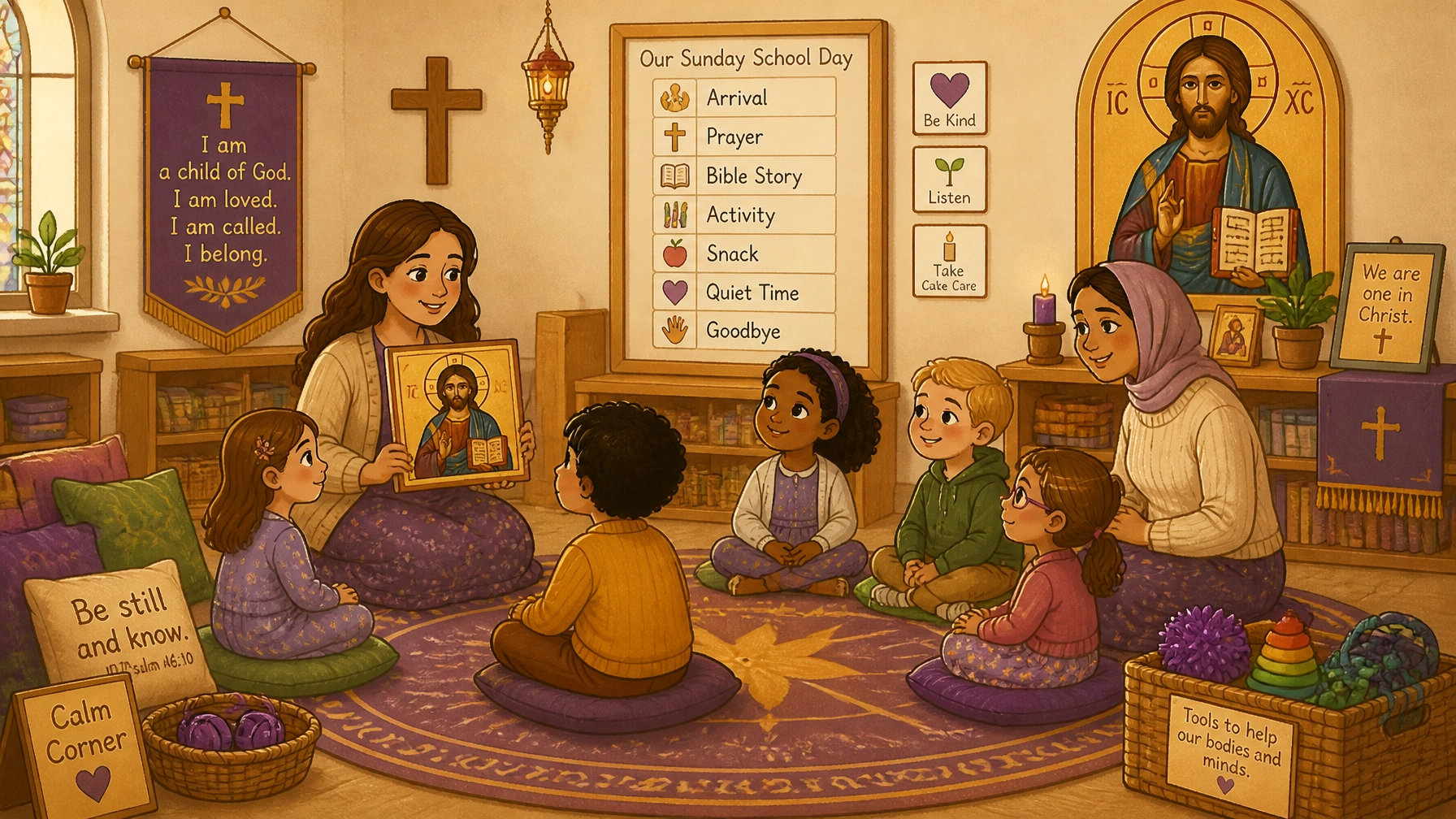
- Seating Options: Does every child have to sit rigidly at a desk, or can we offer floor cushions, rocking chairs, or standing desks?
- Gentle Reminder: There is no shame in a noisy room. We are learning to embrace movement and quiet sounds as living parts of our parish community.
2. Prepare: Gather Your Core Sensory Toolkit (Minutes 2–3)
You don't need a hundred props. In two minutes, assemble a simple, portable "Faith & Calm Kit" using items you likely already have on hand:
- 🎧 Noise-reducing headphones for children sensitive to loud group singing or chanting.
- ⭐ Tactile faith symbols like smooth wooden crosses, soft prayer ropes (choutki), or textured icon cards that children can hold during storytelling.
- ⏳ Visual timers or simple picture cards that map out the lesson flow.
As you prepare, remember our guiding motto: All activities are gentle choices, never tests. Children are always empowered to participate in the way that feels safest for them: whether that means pointing, speaking, moving, or quietly drawing.
3. Welcome: Crafting the Core Lesson with Multi-Sensory Choices (Minutes 4–5)
When reviewing your weekly Bible story, saint's life, or feast day lesson, add three quick multi-sensory options so children can engage with their whole bodies:
- The Tactile Connection: Instead of just listening to a story about Saint Nicholas or the Nativity, let little hands feel soft fleece fabrics, smell frankincense or beeswax, or touch smooth river stones.
- The Visual Anchor: Pair every spoken instruction with a clear picture card or visual schedule ("First we listen, then we touch the icon, then we share a gentle prayer").
- The Freedom to Move: Offer a designated "stretching spot" or a quiet corner where children can take a sensory break without feeling separated from the group.

🌟 Practical Tools You Can Implement This Sunday
Parish leaders often ask us where to start on Sunday morning. Here are three immediate, low-pressure steps you can take this week:
- Create a Quiet Comfort Corner: Set up a small pop-up tent or a cozy corner with bean bags, soft pillows, and a basket of sensory-friendly religious books. Let families know this space is always available for anyone needing a breather.
- Use Visual Schedules: Draw or print simple icons representing the flow of class. When children can see what is happening next, anxiety melts away and anticipation takes its place.
- Partner with Families: Treat parents and caregivers as your greatest spiritual guides. Ask them gently: "What helps your child feel safe and grounded at home?" Their wisdom is an invaluable treasure for your ministry.
💫 Embracing the Beauty of Belonging
Creating a sensory-friendly Sunday school is not about achieving perfection or following a rigid formula. It is about opening our arms wide and saying, "Welcome home. You belong here, exactly as you are."
When we slow down, listen with our hearts, and equip our classrooms with grace, we reflect the unconditional love of the Good Shepherd, who leaves the ninety-nine to welcome every single unique, beautiful lamb.
"Different is a gift of God's diverse creation; every child's heart sings its own holy melody unto the Lord." 🕊️
Let us step forward into this holy work together: one gentle breath, one inclusive smile, and one blessed Sunday at a time.
Explore more of our sensory-aware resources, visual storybooks, and parish inclusion tools right here at XTERMIGATOR Kids Hellenic.
Leave a Reply