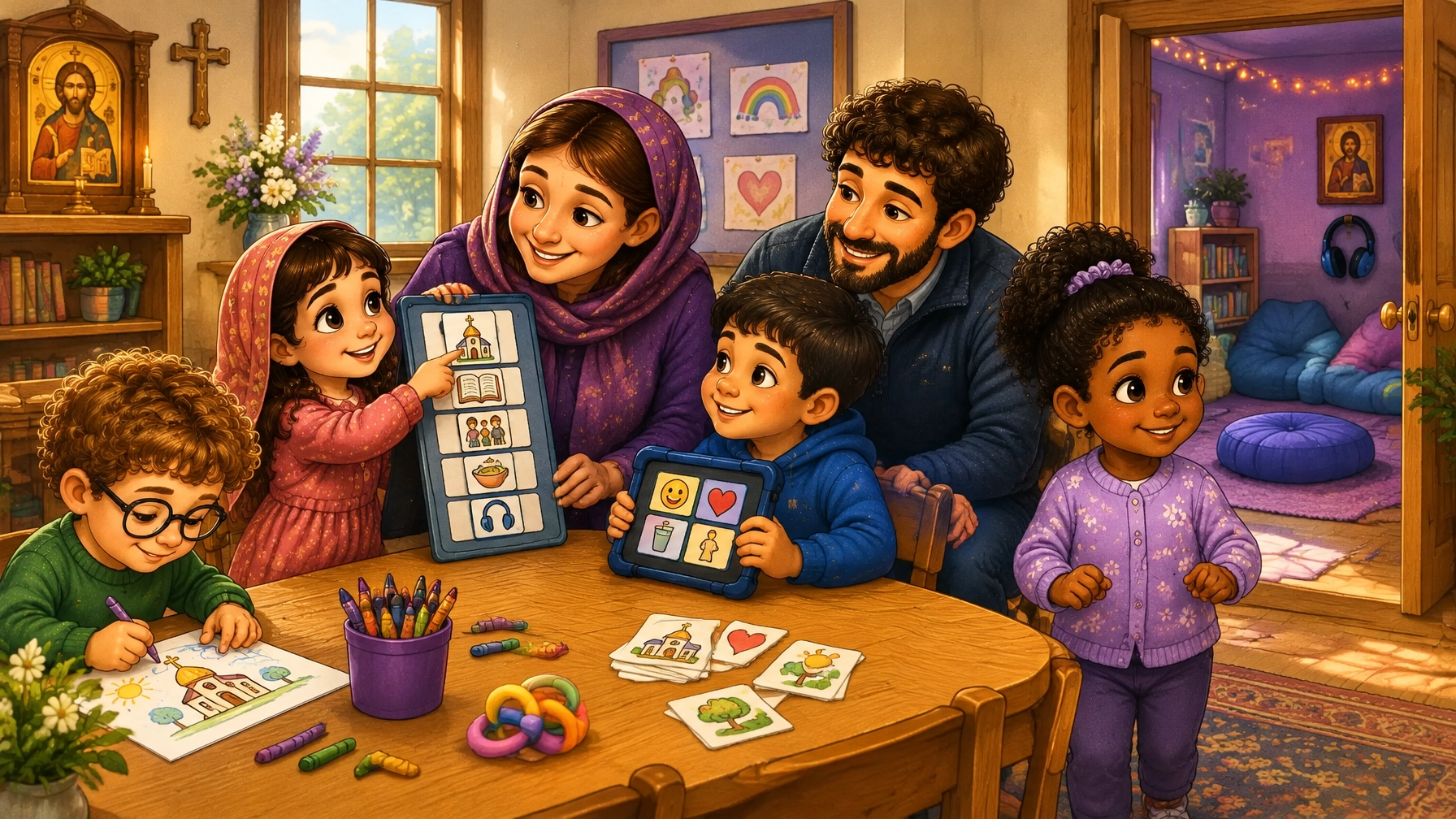
If your parish is deciding between an inclusive Sunday School classroom and a separate special needs ministry, you don’t have to find one answer that fits every child. Neither model is automatically better. They are different tools for helping children learn, connect, and take part in the life of the Church.
For some children, learning alongside same-age peers, with supports built into the classroom, feels right. Others may benefit from a smaller, quieter group, an adapted lesson, or a break from the busy classroom. Many parishes use a blend: a shared class with flexible supports and a calm space or small-group option when needed.
The goal isn’t to make every child follow the same path. It’s to build a parish where each child and family can find a meaningful way to belong. 💛
Different is beautiful. Every child belongs in the life of the Church.
🌿 What does inclusive Sunday School look like?
An inclusive Sunday School brings children together in one shared classroom and plans for different ways of learning and participating. Rather than waiting for a child to struggle before offering help, the teacher makes useful supports part of the environment for everyone.
A flexible lesson might include:
- A simple visual schedule showing what happens first, next, and last.
- Pictures, objects, demonstrations, and spoken explanations.
- More than one way to respond: point, speak, move, draw, type, sign, or use a communication device.
- Flexible seating, movement breaks, and permission to listen without joining every activity.
- A predictable routine and gentle preparation for transitions.
- A calm corner or nearby quiet room for a pause.
These supports can help children with sensory sensitivities, autism, ADHD, communication differences, anxiety, or simply a different learning style. They can also make the class easier to follow for any child who benefits from seeing, hearing, and doing.
Inclusive does not mean “everyone must do the same thing.” It means we make room for children to participate in ways that work for them. A child who watches, listens, or takes a break is still part of the community.

🕊️ What is a special needs ministry or self-contained class?
A special needs ministry church program, or a self-contained class, offers religious education in a smaller, quieter, or more individually adapted setting. It may be especially helpful when a child needs a lower-stimulation room, a slower pace, repeated instruction, a consistent adult, or more direct communication support.
Depending on the parish, this can include:
- A small group with an adapted Sunday School curriculum.
- A trained buddy or volunteer who offers consistent support.
- A quieter room with fewer distractions and a predictable routine.
- Lessons adapted through pictures, sensory materials, movement, or shorter activities.
- A choice to join peers for part of class, worship, prayer, or fellowship.
A separate room should not mean a child is forgotten or cut off from parish life. It can be one supportive setting within a wider plan for relationships, worship, learning, and community. The National Catholic Partnership on Disability’s parish-based catechesis guidance describes different approaches to religious education, including participation in typical classrooms with supports and individualized options.
💜 A better question than “Which is better?”
Try asking: What setting and supports would help this child feel safe, communicate, learn, and connect today?
The answer may change over time. A child might begin in a small group and later choose to join the shared classroom. Another might thrive in the main class but need a quiet break space. A family may prefer one option now and revisit it later.
A blended approach can offer both community and flexibility: mainstream Sunday School with a visual schedule and a trained helper, plus a nearby sensory break space or occasional small-group lesson. The quiet space can be available without being treated as a punishment or a permanent assignment.

✨ Use Notice–Prepare–Welcome to guide your decision
This simple lens can help a parish move from good intentions to practical support.
1. Notice: Learn what matters to the child
Begin with strengths, preferences, and the child’s own ways of communicating, not assumptions based on a diagnosis. What feels comfortable? What sounds, transitions, crowds, or activities may be hard? What helps when the child needs a pause?
A family may share helpful information, but families should not have to prove that a child belongs. Invite conversation with care and respect privacy.
2. Prepare: Make a few supports ready
Before the first class, prepare a visual schedule, a flexible lesson, a clear plan for transitions, and a calm place to take a break. Decide who will welcome the family and who is responsible for support. A simple, reusable lesson plan with choices can make Sunday School curriculum more accessible without requiring a separate activity for every child.
3. Welcome: Offer real choices and keep listening
Explain the available options to the child and family. Try the agreed approach, notice what feels comfortable and meaningful, and check in afterward. Participation does not need to look perfect or last the whole class. We can pause, breathe, listen, and adjust together.
🧭 Questions to help your parish choose
There is no single checklist that can decide for a family. These questions can help parish leaders, priests, teachers, and catechists plan a thoughtful conversation:
- Sensory profile: What sounds, lighting, movement, textures, or group size feel comfortable? Would the child like access to a quieter space?
- Communication: How does the child express interest, needs, yes, or no? Do pictures, gestures, speech, signing, or a communication device help?
- Family preference: What does the child enjoy? What would the family like to try first? What would help them feel welcome and confident?
- Parish capacity: How many trained, screened volunteers can support the program? Is there a suitable classroom, a calm area, or a way to adapt lessons?
- Meaningful connection: How will the child build relationships and participate in worship, prayer, feast days, or fellowship in a way that works for them?
Most importantly, the child and family should help choose the plan. A classroom should not be assigned to a child simply because of a label, nor should a child be expected to remain in a setting that isn’t working. Consider a trial period and a check-in date, with the understanding that the plan can change.
For practical ideas on visual supports, flexible participation, and team preparation, explore our parish inclusion tools. For a lesson connection to Orthodox tradition, our saints and name days activities offer options for learning through stories, prayer, drawing, and reflection.
🪜 First steps you can take this month
You do not need to build a complete program before making the next small improvement. Start with one or two steps:
- Choose a welcome contact. Give families one kind, clear person to speak with before or after class.
- Ask, then listen. Invite the family to share what helps the child participate and what the child enjoys. Offer choices rather than making assumptions.
- Make one lesson flexible. Add a visual “first–then” schedule and offer a choice to speak, point, draw, or move.
- Prepare a calm option. Identify a quiet room or corner and explain that children may use it as needed.
- Clarify volunteer roles. Make sure helpers know how to support communication, respect privacy, and follow parish safety procedures.
- Check in and adjust. Ask the family what felt helpful and what might make the next visit easier.

These are ready-to-use steps, not a test of whether your parish has done enough. Begin where you are, and keep learning together.
🌟 Belonging is the measure
An inclusive classroom and a special needs ministry are not competing answers. They are part of a wider set of ways a parish can offer welcome, learning, and connection. The right plan is one that respects the child, listens to the family, and makes participation possible without pressure or shame.
We can offer a shared class, a smaller group, a quiet space, a trained buddy, or a blend that changes as the child’s needs and preferences change. The important thing is that the child is invited into the life of the Church as a valued member, not treated as a problem to solve.
Different is beautiful. Every child belongs in the life of the Church. 🤍
Leave a Reply