The new Greek Orthodox Archdiocese of America K–12 Sunday School curriculum brings fresh structure and resources to parish classrooms. It was launched at the 2026 Clergy-Laity Congress in Cleveland on June 30, developed by the Department of Religious Education with St. Spyridon, Orthodox Pebbles, and a team led by Dr. Drew Baker. Its five developmental levels include structured lesson plans, unit resources, instructional tools, and training materials available through the GOA Sunday School curriculum portal.
And now many teachers are opening those materials and asking a quiet, important question: How can I make this work for the children who need more support?
If that is you, take a breath. You do not need to write a second curriculum or become an expert in every support strategy before Sunday. We can begin with one lesson, a few thoughtful choices, and the children in front of us.
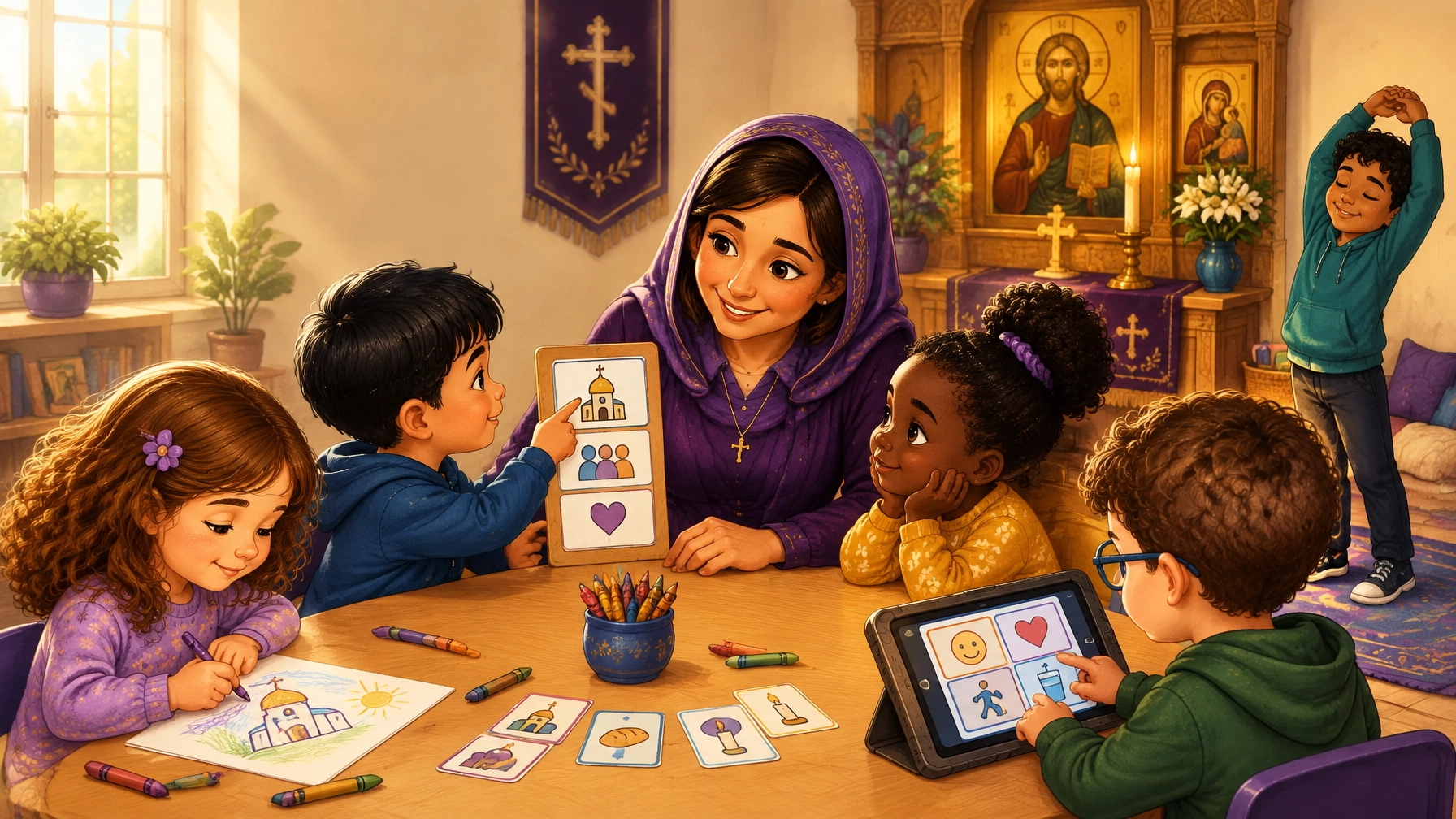
The goal is not to make every child participate in the same way. It is to make room for each child to connect with the lesson: by pointing, speaking, moving, drawing, listening, or taking a pause. Every one of those is a gentle choice, not a test.
One lesson can hold many ways to belong. ✨
Start with the lesson you already have
The new curriculum offers a shared structure for Orthodox Christian religious education across developmental levels. Its materials are designed to support parish teaching, and the training addressed adaptation across ages and developmental stages. For neurodiverse learners, the next step can be simple: review the lesson for places where we can make expectations clearer, participation more flexible, and transitions gentler.
That is not a criticism of the curriculum, or of the catechist. It is a practical way to help more children access the same faith formation. Some children may find spoken directions hard to hold in mind. Some may need movement to listen. Others may be ready to respond but not with speech. A small adjustment can make the lesson easier to approach without changing its Orthodox content.

Use Notice–Prepare–Welcome to review any lesson
Think of this as a compassionate lens, not another form to fill out. You can use it with a lesson from any developmental level.
1. Notice: What might a child need to know or navigate?
Take a quick look through the lesson. Notice its steps, materials, transitions, and invitations to participate.
Ask yourself:
- Are there several spoken instructions in a row?
- Is there a change of activity that might benefit from a warning?
- Does the lesson involve waiting, noise, touch, or an unfamiliar material?
- Is the expected response mostly speaking or writing?
- Where could a child take a short pause and rejoin?
We are not trying to predict every need or prevent every hard moment. We are simply looking closer, with curiosity rather than judgment. When possible, ask families what helps their child feel prepared and how the child communicates. Families know their children well, and partnership can make a small plan much more useful.
2. Prepare: Choose one or two supports
You do not need to create a polished packet. A quick sketch, a few picture cards, or a simple verbal preview may be enough.
Consider preparing:
- A visual schedule: “Gather → Listen or look → Choose an activity → Finish.”
- A communication choice: “You can point, tell me, draw, sign, or use your device.”
- A movement option: Stand, stretch, carry materials, or take a brief walk with an adult.
- A flexible response: Let children show what they understood by choosing a picture, drawing, speaking, or demonstrating.
- A pause plan: Identify a calmer seat or a nearby space where a child can step out and return.
These supports do not need to be fancy. Their purpose is to help a child understand what is happening and what choices are available. A small card that says “break” or a two-picture sequence can be more useful than an elaborate resource that takes hours to prepare.

3. Welcome: Offer the choices without pressure
At the start, show or explain the plan in a calm, friendly way. Let children know what comes next and where they can find support. Then offer participation options as ordinary parts of the lesson, not as special exceptions that call attention to one child.
A child might listen from the edge of the group, answer by pointing, draw a response, or join the movement activity and skip the craft. They may take a break. They may return. They may observe without responding at all.
We can keep the invitation open: “Would you like to point, draw, tell me, or just listen?” If a child does not choose, we can wait. Participation is a gentle invitation, never proof of attention, learning, or faith.
We make space. Each child chooses a way in. 💛
The five-minute lesson tweak checklist
Before Sunday, try this small three-step routine. Set a timer if that feels helpful, but there is no need to finish perfectly. The point is a usable first step.
Minute 1–2: Pick the key parts
Look over the lesson and identify its main idea, one or two activity steps, and how you will signal that the activity is ending. You do not need to adapt every detail.
Minute 3–4: Add one visual and one response choice
Write or draw a simple sequence of what will happen. Choose at least two ways a child can respond, for example, speaking or pointing, drawing or choosing a picture. If you already have communication supports, bring them within reach.
Minute 5: Plan one movement or pause option
Decide how a child can stretch, move with a purpose, or take a short break and return. Tell the class that these options are available to everyone. A predictable, matter-of-fact plan can help children feel safer before they need it.
Quick checklist:
- ☐ I know the key parts of the lesson.
- ☐ I have a simple visual sequence and more than one way to respond.
- ☐ I can offer movement or a pause without shame or pressure.
That is a real start. If Sunday arrives and you have prepared only one of these, that still counts. We are building a welcoming practice together, one small choice at a time.
Keep the lesson shared, not separate
Inclusive Sunday School does not mean creating a separate curriculum for children who need support. It means offering one lesson with flexible ways to access it. The theological purpose remains; the path into the learning becomes wider.
For example, during a lesson that invites children to reflect on an Orthodox teaching, one child might answer aloud, another might point to a picture, and another might draw. A child who needs movement might stand at the back or help carry supplies. A child who needs quiet might listen from a calmer spot. They are still part of the same classroom community.

This approach can also help the whole group. Visual steps make transitions easier to follow. Choice-based responses make it possible for more children to share. Planned movement can bring energy down rather than turning it into a problem. And when breaks are treated as normal, children do not have to earn the right to regulate.
For more practical ideas for welcoming families and creating flexible participation options, explore our parish inclusion tools. Our saints and name days activities also model ways children can read, listen, point, draw, write, or talk with a trusted adult.
Prepare before Sunday, gently
Open the GOA K–12 curriculum resources, choose the lesson your class will use, and spend five minutes noticing where a visual, a communication choice, or a movement break might help. You can also share your plan with a co-teacher or invite families to tell you what works for their child.
We will not always know what a child needs in advance. We do not have to. We can pause, breathe, listen, and adjust together. A lesson can be faithful, structured, and flexible all at once, and every child can belong without having to participate in exactly the same way.
Different is beautiful. Every child belongs in the life of the Church. 🕯️
Leave a Reply