Category: Blog

Your blog category

  • Why do we do our cross?

    Why do we do our cross?

    Father Lou Corner
    Not a quotation or approved teaching in his name.

    Hello, children! Have you noticed people making the sign of the cross when we pray? It is a small prayer we make with our bodies. It reminds us of Jesus Christ, His Cross, and His love for us.

    When we say, "In the name of the Father, and of the Son, and of the Holy Spirit," we are praying to the Holy Trinity: one God in three Persons.

    In our Orthodox tradition, we bring the thumb and first two fingertips of our right hand together. Those three fingers remind us of the Holy Trinity. The other two fingers rest against our palm and remind us that Jesus Christ is fully God and fully human.

    We gently touch our forehead, chest, right shoulder, and then left shoulder. We take our time. This is prayer, not a race or a trick for getting what we want.

    If moving your hand this way is hard, you can pray in words or quietly in your heart. A grown-up can help you find a comfortable way to take part. You belong here, too.

    Try it together

    With a trusted grown-up, slowly say the prayer and make the sign of the cross if that is comfortable for you. You may also watch, listen, or pray silently.

    Wonder together

    When could you pause for a little prayer this week?

    Family note

    This is a short introduction to Greek Orthodox practice. Ask your priest for help with questions or with adapting the movement to your child's needs.

    Sources

    Holy Trinity Saint Nicholas Greek Orthodox Church, “The Sign Of The Cross”

    Frederica Mathewes-Green, “12 Things I Wish I Knew” (edited), Assumption Church of the Blessed Virgin

  • Inclusive Sunday School vs. Special Needs Ministry: Which Is Better for Your Parish?

    Inclusive Sunday School vs. Special Needs Ministry: Which Is Better for Your Parish?

    If your parish is deciding between an inclusive Sunday School classroom and a separate special needs ministry, you don’t have to find one answer that fits every child. Neither model is automatically better. They are different tools for helping children learn, connect, and take part in the life of the Church.

    For some children, learning alongside same-age peers, with supports built into the classroom, feels right. Others may benefit from a smaller, quieter group, an adapted lesson, or a break from the busy classroom. Many parishes use a blend: a shared class with flexible supports and a calm space or small-group option when needed.

    The goal isn’t to make every child follow the same path. It’s to build a parish where each child and family can find a meaningful way to belong. 💛

    Different is beautiful. Every child belongs in the life of the Church.

    🌿 What does inclusive Sunday School look like?

    An inclusive Sunday School brings children together in one shared classroom and plans for different ways of learning and participating. Rather than waiting for a child to struggle before offering help, the teacher makes useful supports part of the environment for everyone.

    A flexible lesson might include:

    • A simple visual schedule showing what happens first, next, and last.
    • Pictures, objects, demonstrations, and spoken explanations.
    • More than one way to respond: point, speak, move, draw, type, sign, or use a communication device.
    • Flexible seating, movement breaks, and permission to listen without joining every activity.
    • A predictable routine and gentle preparation for transitions.
    • A calm corner or nearby quiet room for a pause.

    These supports can help children with sensory sensitivities, autism, ADHD, communication differences, anxiety, or simply a different learning style. They can also make the class easier to follow for any child who benefits from seeing, hearing, and doing.

    Inclusive does not mean “everyone must do the same thing.” It means we make room for children to participate in ways that work for them. A child who watches, listens, or takes a break is still part of the community.

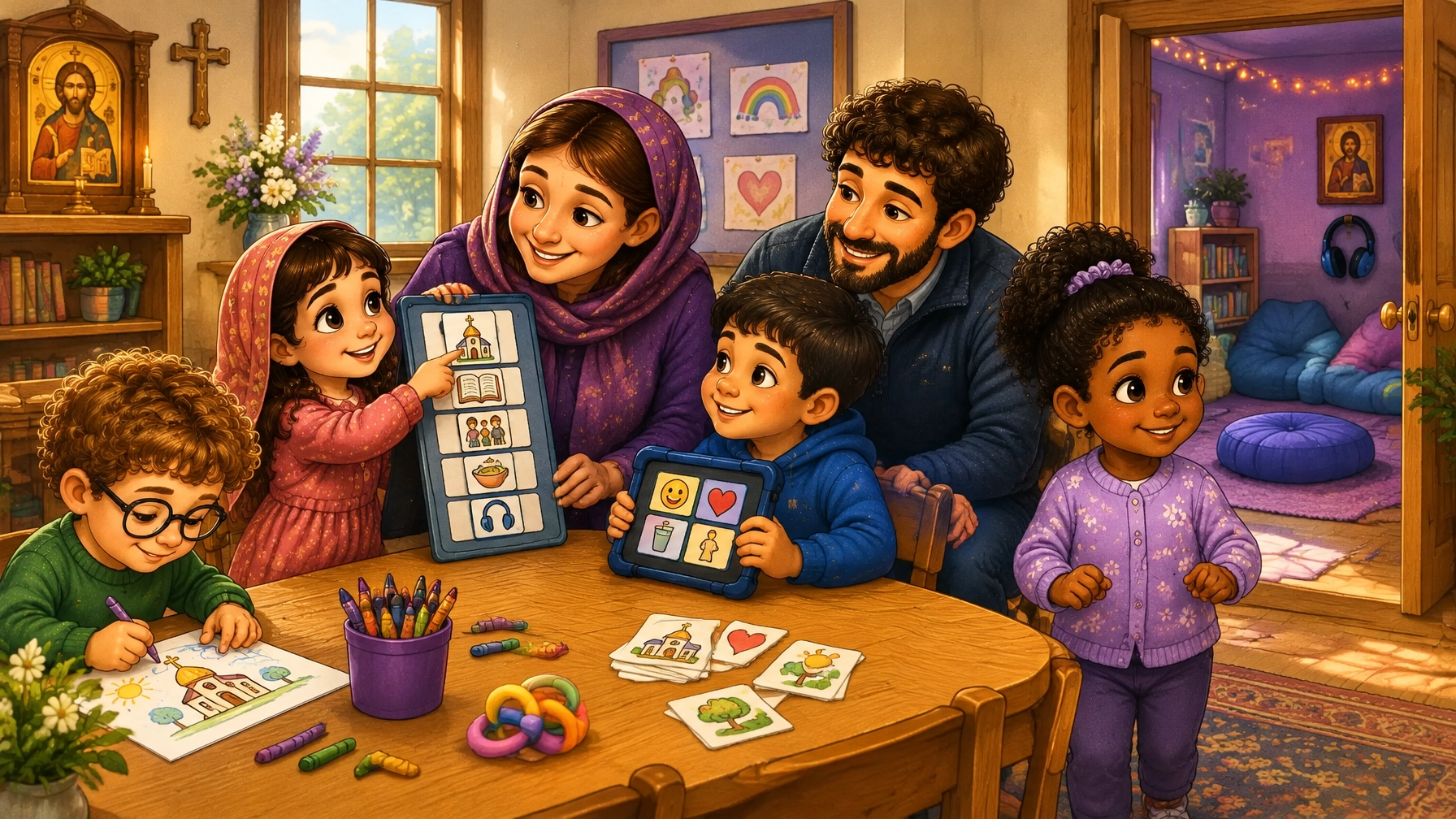
    A child experiencing sensory overload in church is met with understanding and a gentle option to take a break

    🕊️ What is a special needs ministry or self-contained class?

    A special needs ministry church program, or a self-contained class, offers religious education in a smaller, quieter, or more individually adapted setting. It may be especially helpful when a child needs a lower-stimulation room, a slower pace, repeated instruction, a consistent adult, or more direct communication support.

    Depending on the parish, this can include:

    • A small group with an adapted Sunday School curriculum.
    • A trained buddy or volunteer who offers consistent support.
    • A quieter room with fewer distractions and a predictable routine.
    • Lessons adapted through pictures, sensory materials, movement, or shorter activities.
    • A choice to join peers for part of class, worship, prayer, or fellowship.

    A separate room should not mean a child is forgotten or cut off from parish life. It can be one supportive setting within a wider plan for relationships, worship, learning, and community. The National Catholic Partnership on Disability’s parish-based catechesis guidance describes different approaches to religious education, including participation in typical classrooms with supports and individualized options.

    💜 A better question than “Which is better?”

    Try asking: What setting and supports would help this child feel safe, communicate, learn, and connect today?

    The answer may change over time. A child might begin in a small group and later choose to join the shared classroom. Another might thrive in the main class but need a quiet break space. A family may prefer one option now and revisit it later.

    A blended approach can offer both community and flexibility: mainstream Sunday School with a visual schedule and a trained helper, plus a nearby sensory break space or occasional small-group lesson. The quiet space can be available without being treated as a punishment or a permanent assignment.

    Children and families share prayer, learning, service, worship, and love as one church community

    ✨ Use Notice–Prepare–Welcome to guide your decision

    This simple lens can help a parish move from good intentions to practical support.

    1. Notice: Learn what matters to the child

    Begin with strengths, preferences, and the child’s own ways of communicating, not assumptions based on a diagnosis. What feels comfortable? What sounds, transitions, crowds, or activities may be hard? What helps when the child needs a pause?

    A family may share helpful information, but families should not have to prove that a child belongs. Invite conversation with care and respect privacy.

    2. Prepare: Make a few supports ready

    Before the first class, prepare a visual schedule, a flexible lesson, a clear plan for transitions, and a calm place to take a break. Decide who will welcome the family and who is responsible for support. A simple, reusable lesson plan with choices can make Sunday School curriculum more accessible without requiring a separate activity for every child.

    3. Welcome: Offer real choices and keep listening

    Explain the available options to the child and family. Try the agreed approach, notice what feels comfortable and meaningful, and check in afterward. Participation does not need to look perfect or last the whole class. We can pause, breathe, listen, and adjust together.

    🧭 Questions to help your parish choose

    There is no single checklist that can decide for a family. These questions can help parish leaders, priests, teachers, and catechists plan a thoughtful conversation:

    • Sensory profile: What sounds, lighting, movement, textures, or group size feel comfortable? Would the child like access to a quieter space?
    • Communication: How does the child express interest, needs, yes, or no? Do pictures, gestures, speech, signing, or a communication device help?
    • Family preference: What does the child enjoy? What would the family like to try first? What would help them feel welcome and confident?
    • Parish capacity: How many trained, screened volunteers can support the program? Is there a suitable classroom, a calm area, or a way to adapt lessons?
    • Meaningful connection: How will the child build relationships and participate in worship, prayer, feast days, or fellowship in a way that works for them?

    Most importantly, the child and family should help choose the plan. A classroom should not be assigned to a child simply because of a label, nor should a child be expected to remain in a setting that isn’t working. Consider a trial period and a check-in date, with the understanding that the plan can change.

    For practical ideas on visual supports, flexible participation, and team preparation, explore our parish inclusion tools. For a lesson connection to Orthodox tradition, our saints and name days activities offer options for learning through stories, prayer, drawing, and reflection.

    🪜 First steps you can take this month

    You do not need to build a complete program before making the next small improvement. Start with one or two steps:

    1. Choose a welcome contact. Give families one kind, clear person to speak with before or after class.
    2. Ask, then listen. Invite the family to share what helps the child participate and what the child enjoys. Offer choices rather than making assumptions.
    3. Make one lesson flexible. Add a visual “first–then” schedule and offer a choice to speak, point, draw, or move.
    4. Prepare a calm option. Identify a quiet room or corner and explain that children may use it as needed.
    5. Clarify volunteer roles. Make sure helpers know how to support communication, respect privacy, and follow parish safety procedures.
    6. Check in and adjust. Ask the family what felt helpful and what might make the next visit easier.

    A child explores simple sensory-friendly tools for a calmer, more flexible church experience

    These are ready-to-use steps, not a test of whether your parish has done enough. Begin where you are, and keep learning together.

    🌟 Belonging is the measure

    An inclusive classroom and a special needs ministry are not competing answers. They are part of a wider set of ways a parish can offer welcome, learning, and connection. The right plan is one that respects the child, listens to the family, and makes participation possible without pressure or shame.

    We can offer a shared class, a smaller group, a quiet space, a trained buddy, or a blend that changes as the child’s needs and preferences change. The important thing is that the child is invited into the life of the Church as a valued member, not treated as a problem to solve.

    Different is beautiful. Every child belongs in the life of the Church. 🤍

  • The New GOA K-12 Sunday School Curriculum Just Launched, Here’s How to Make It Work for Neurodiverse Learners

    The New GOA K-12 Sunday School Curriculum Just Launched, Here’s How to Make It Work for Neurodiverse Learners

    The new Greek Orthodox Archdiocese of America K–12 Sunday School curriculum brings fresh structure and resources to parish classrooms. It was launched at the 2026 Clergy-Laity Congress in Cleveland on June 30, developed by the Department of Religious Education with St. Spyridon, Orthodox Pebbles, and a team led by Dr. Drew Baker. Its five developmental levels include structured lesson plans, unit resources, instructional tools, and training materials available through the GOA Sunday School curriculum portal.

    And now many teachers are opening those materials and asking a quiet, important question: How can I make this work for the children who need more support?

    If that is you, take a breath. You do not need to write a second curriculum or become an expert in every support strategy before Sunday. We can begin with one lesson, a few thoughtful choices, and the children in front of us.

    The goal is not to make every child participate in the same way. It is to make room for each child to connect with the lesson: by pointing, speaking, moving, drawing, listening, or taking a pause. Every one of those is a gentle choice, not a test.

    One lesson can hold many ways to belong. ✨

    Start with the lesson you already have

    The new curriculum offers a shared structure for Orthodox Christian religious education across developmental levels. Its materials are designed to support parish teaching, and the training addressed adaptation across ages and developmental stages. For neurodiverse learners, the next step can be simple: review the lesson for places where we can make expectations clearer, participation more flexible, and transitions gentler.

    That is not a criticism of the curriculum, or of the catechist. It is a practical way to help more children access the same faith formation. Some children may find spoken directions hard to hold in mind. Some may need movement to listen. Others may be ready to respond but not with speech. A small adjustment can make the lesson easier to approach without changing its Orthodox content.

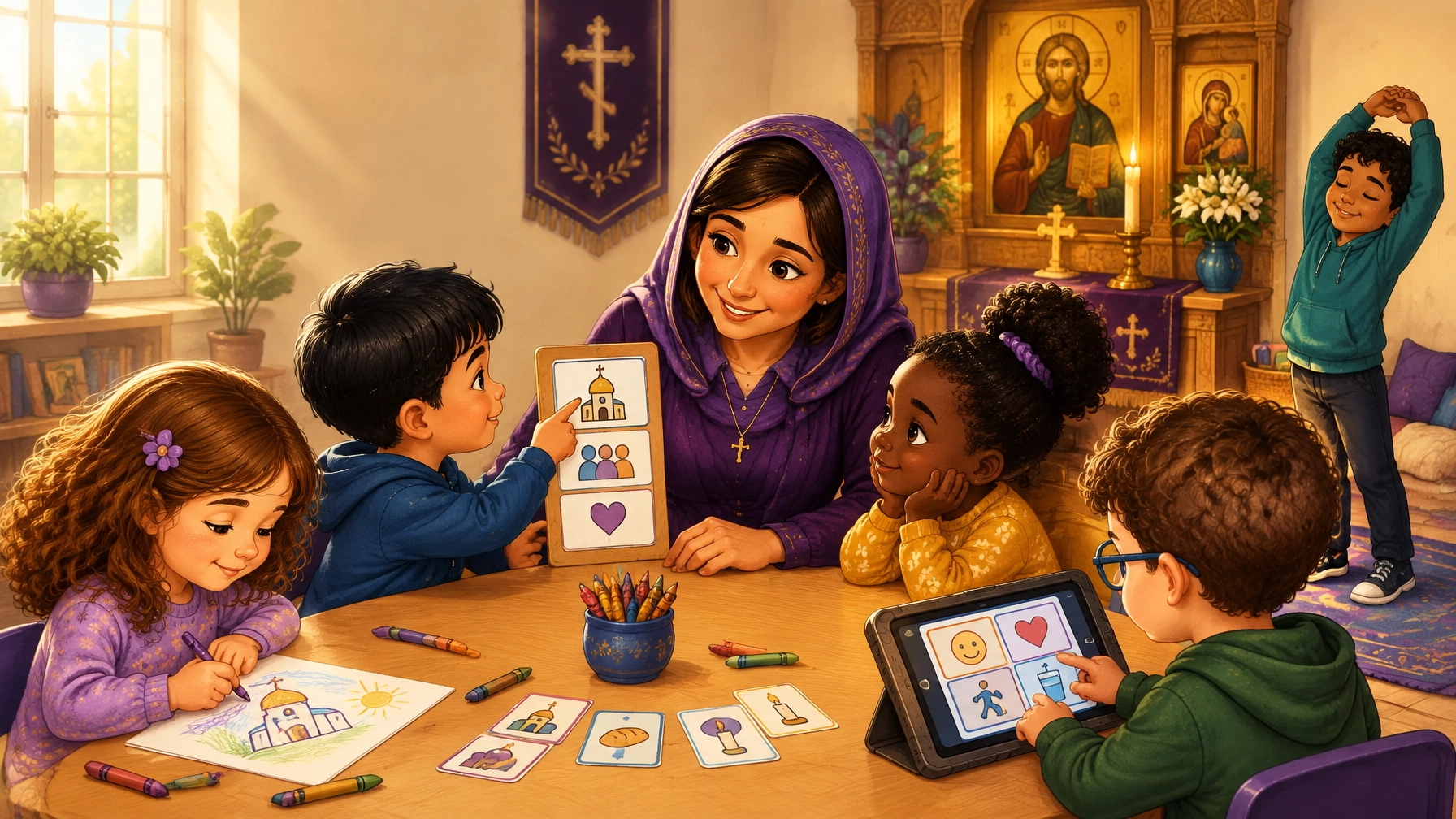
    A gentle visual of a child using a calm space and supportive tools at church

    Use Notice–Prepare–Welcome to review any lesson

    Think of this as a compassionate lens, not another form to fill out. You can use it with a lesson from any developmental level.

    1. Notice: What might a child need to know or navigate?

    Take a quick look through the lesson. Notice its steps, materials, transitions, and invitations to participate.

    Ask yourself:

    • Are there several spoken instructions in a row?
    • Is there a change of activity that might benefit from a warning?
    • Does the lesson involve waiting, noise, touch, or an unfamiliar material?
    • Is the expected response mostly speaking or writing?
    • Where could a child take a short pause and rejoin?

    We are not trying to predict every need or prevent every hard moment. We are simply looking closer, with curiosity rather than judgment. When possible, ask families what helps their child feel prepared and how the child communicates. Families know their children well, and partnership can make a small plan much more useful.

    2. Prepare: Choose one or two supports

    You do not need to create a polished packet. A quick sketch, a few picture cards, or a simple verbal preview may be enough.

    Consider preparing:

    • A visual schedule: “Gather → Listen or look → Choose an activity → Finish.”
    • A communication choice: “You can point, tell me, draw, sign, or use your device.”
    • A movement option: Stand, stretch, carry materials, or take a brief walk with an adult.
    • A flexible response: Let children show what they understood by choosing a picture, drawing, speaking, or demonstrating.
    • A pause plan: Identify a calmer seat or a nearby space where a child can step out and return.

    These supports do not need to be fancy. Their purpose is to help a child understand what is happening and what choices are available. A small card that says “break” or a two-picture sequence can be more useful than an elaborate resource that takes hours to prepare.

    Children learning together through different activities in an Orthodox faith community

    3. Welcome: Offer the choices without pressure

    At the start, show or explain the plan in a calm, friendly way. Let children know what comes next and where they can find support. Then offer participation options as ordinary parts of the lesson, not as special exceptions that call attention to one child.

    A child might listen from the edge of the group, answer by pointing, draw a response, or join the movement activity and skip the craft. They may take a break. They may return. They may observe without responding at all.

    We can keep the invitation open: “Would you like to point, draw, tell me, or just listen?” If a child does not choose, we can wait. Participation is a gentle invitation, never proof of attention, learning, or faith.

    We make space. Each child chooses a way in. 💛

    The five-minute lesson tweak checklist

    Before Sunday, try this small three-step routine. Set a timer if that feels helpful, but there is no need to finish perfectly. The point is a usable first step.

    Minute 1–2: Pick the key parts

    Look over the lesson and identify its main idea, one or two activity steps, and how you will signal that the activity is ending. You do not need to adapt every detail.

    Minute 3–4: Add one visual and one response choice

    Write or draw a simple sequence of what will happen. Choose at least two ways a child can respond, for example, speaking or pointing, drawing or choosing a picture. If you already have communication supports, bring them within reach.

    Minute 5: Plan one movement or pause option

    Decide how a child can stretch, move with a purpose, or take a short break and return. Tell the class that these options are available to everyone. A predictable, matter-of-fact plan can help children feel safer before they need it.

    Quick checklist:

    1. ☐ I know the key parts of the lesson.
    2. ☐ I have a simple visual sequence and more than one way to respond.
    3. ☐ I can offer movement or a pause without shame or pressure.

    That is a real start. If Sunday arrives and you have prepared only one of these, that still counts. We are building a welcoming practice together, one small choice at a time.

    Keep the lesson shared, not separate

    Inclusive Sunday School does not mean creating a separate curriculum for children who need support. It means offering one lesson with flexible ways to access it. The theological purpose remains; the path into the learning becomes wider.

    For example, during a lesson that invites children to reflect on an Orthodox teaching, one child might answer aloud, another might point to a picture, and another might draw. A child who needs movement might stand at the back or help carry supplies. A child who needs quiet might listen from a calmer spot. They are still part of the same classroom community.

    A child exploring supportive tools for a calmer and more predictable church experience

    This approach can also help the whole group. Visual steps make transitions easier to follow. Choice-based responses make it possible for more children to share. Planned movement can bring energy down rather than turning it into a problem. And when breaks are treated as normal, children do not have to earn the right to regulate.

    For more practical ideas for welcoming families and creating flexible participation options, explore our parish inclusion tools. Our saints and name days activities also model ways children can read, listen, point, draw, write, or talk with a trusted adult.

    Prepare before Sunday, gently

    Open the GOA K–12 curriculum resources, choose the lesson your class will use, and spend five minutes noticing where a visual, a communication choice, or a movement break might help. You can also share your plan with a co-teacher or invite families to tell you what works for their child.

    We will not always know what a child needs in advance. We do not have to. We can pause, breathe, listen, and adjust together. A lesson can be faithful, structured, and flexible all at once, and every child can belong without having to participate in exactly the same way.

    Different is beautiful. Every child belongs in the life of the Church. 🕯️

  • When Your Child Won’t Sit Through Church: 7 Gentle Truths for Weary Orthodox Parents

    When Your Child Won’t Sit Through Church: 7 Gentle Truths for Weary Orthodox Parents

    If your child cannot sit through the Divine Liturgy, please pause for a moment.

    Breathe in. Breathe out. Let your shoulders soften.

    You are not a bad Orthodox parent. Your child is not a bad child. And your family is not failing at church.

    Mid-October can feel especially full: school routines, changing weather, crowded parish calendars, feast days, and tired bodies. By Sunday morning, your child may already be carrying more sensory input, transition stress, or fatigue than anyone can see.

    When a child moves, hums, covers their ears, runs, cries, or needs to leave, it is easy to hear an inner voice saying, Everyone else’s child can manage this. Why can’t mine?

    Together, let’s gently set that voice down.

    In orthodox Christian parenting, “won’t sit still” often means “my body needs help to feel safe and regulated.” That is not an excuse to ignore reverence, safety, or the guidance of your priest. It is an invitation to look closer and respond with wisdom rather than shame.

    The following seven truths are not another long list of expectations. They are a quiet emotional companion for weary families: seven ways to understand church participation with more mercy.

    Your family does not have to earn its place in the Church. You already belong. ☦️

    1. Your child’s belonging does not depend on sitting still

    Your child is already a beloved member of the Body of Christ. Their baptism, their presence, and God’s love are not conditional on perfect behavior.

    Orthodox pastoral guidance from the Orthodox Church in America reminds communities to meet families affected by invisible disabilities with love, compassion, and acceptance. ADHD, autism, anxiety, sensory processing differences, and communication differences may not be visible, but their effects can be very real.

    Your child does not become more worthy when they are quiet. They do not become less Orthodox when they need to move, step outside, use headphones, or communicate without speech.

    Try this instead: Take a movement break

    Before your child reaches a crisis point, offer a brief walk in the narthex, a stretch near the back, or a few slow movements outside the nave. A movement break is not “giving in.” It may be the support that makes returning possible.

    If returning is not possible, that is information, not failure.

    A child who needs to move is still a child who belongs. 💛

    2. Regulation needs are not the same as irreverence

    You may worry that movement, fidgets, vocalizations, or stepping out look disrespectful. That concern comes from a sincere love for Orthodox worship and a desire to teach your child reverence.

    We can honor that desire while also recognizing that reverence does not always look like stillness.

    A child who rocks, taps, chews, or watches the light may be regulating their nervous system. A child who covers their ears during loud chanting may be protecting themselves from pain. A child who cannot answer aloud may still be listening, praying, or connecting deeply.

    We can teach boundaries gently: hands stay safe, sacred objects are treated with care, and everyone’s body matters. But we do not need to assume that every movement is defiance.

    Child-friendly visual support for church sounds, feelings, and sensory awareness

    Try this instead: Use a visual schedule

    A simple picture schedule can show what comes next: arrive, light a candle, stand or sit, listen, take a break, return if ready, and receive a blessing or Communion according to your priest’s guidance.

    Predictability can make worship feel less like a series of surprises. You can create one at home, ask your parish to help, or explore the family and parish resources from XTERMIGATOR Kids Hellenic.

    We can preserve the beauty of Tradition while removing unnecessary barriers to participation. ✨

    3. The goal is connection, not perfect endurance

    The Divine Liturgy is not a test your child must pass from beginning to end.

    For some children, participation may mean standing for five minutes, listening from the narthex, looking at an icon, lighting a candle, receiving Holy Communion, or returning for the final prayers. For another child, participation may mean being present for the whole service with frequent movement.

    There is no single faithful way for every nervous system.

    If your child becomes overwhelmed, leaving the nave can be a compassionate response. You are not abandoning worship. You are helping your child remain connected to church in a sustainable way.

    Try this instead: Bring a few quiet church toolbox items

    Choose one or two familiar supports, not an entire entertainment center. A soft fidget, a small drawing pad, a comfort object, noise-reducing headphones, or a tactile item may help your child listen and remain present.

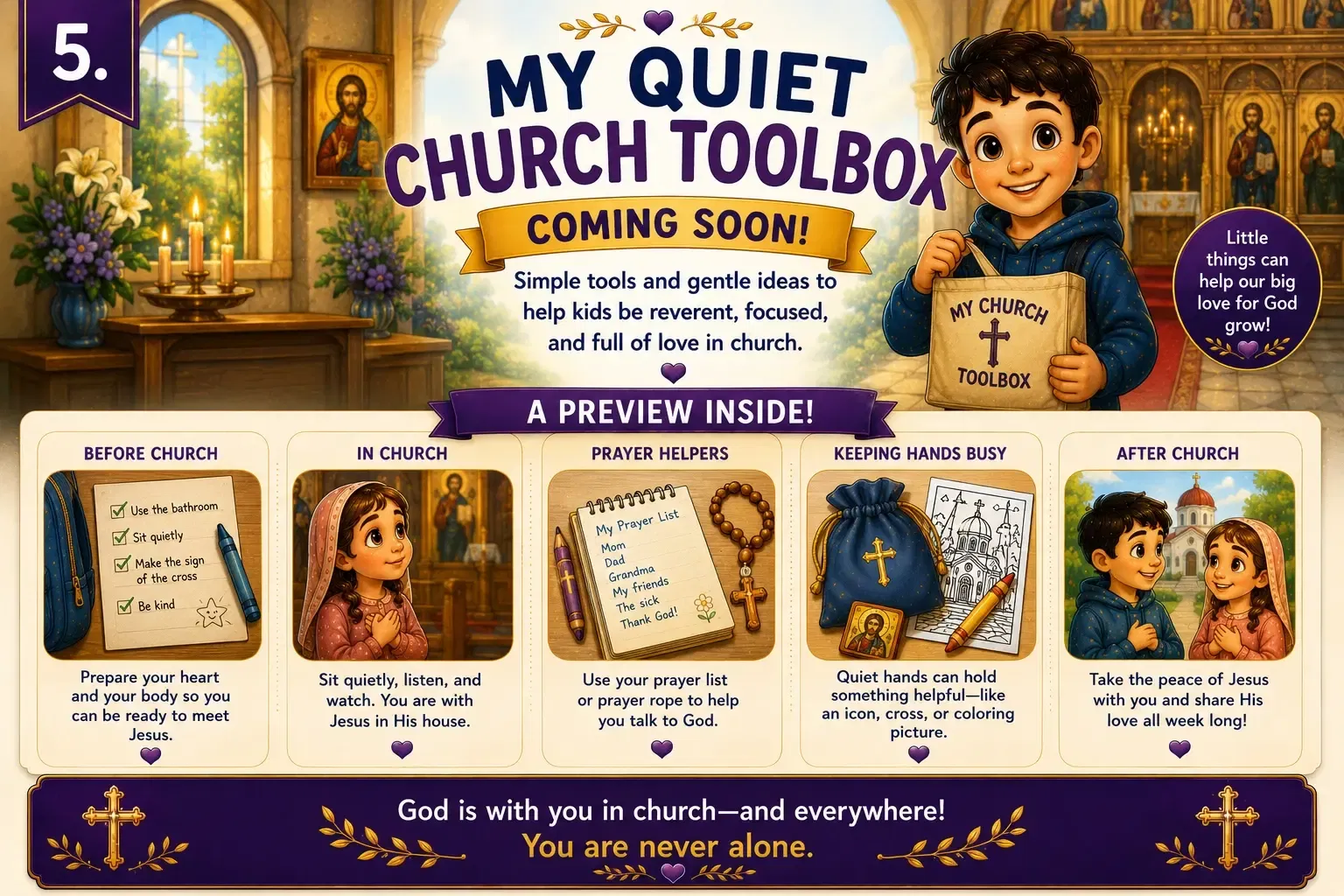
    The My Quiet Church Toolbox resource is designed around calm, focus, prayer, and joyful participation. These tools are not rewards for “good behavior.” They are supports that help a child access the experience.

    Small supports can open a wide door to worship. 🕯️

    4. Seating is a support, not a statement about your family

    Some families feel watched when they choose the back of the church, a side aisle, or a quieter chapel area. Please know that choosing a lower-stimulation space is not a sign that you are less committed to the parish.

    It may simply be the wisest place for your child’s body today.

    The front may help one child see clearly. The back may help another child move safely. A side chapel may offer less crowding. A place near an exit may reduce anxiety because your child knows there is a way out.

    You are allowed to experiment.

    Try this instead: Sit at the back or in a side chapel

    Ask your priest or parish welcome lead which spaces are appropriate and available. You might try one location for several Sundays, then gently notice what helps: less noise, fewer people passing by, a clearer view, or easier access to a break.

    There is no shame in choosing the seat that supports connection.

    The best seat is the one where your family can breathe. 🌿

    5. Communication can look like pointing, signing, moving, or drawing

    A child does not need to speak in order to respond to God, learn about the saints, or participate in family prayer.

    Some children point to an icon. Some sign, use AAC, hum, gesture, draw, or choose between pictures. Some communicate through their eyes, posture, or movement. These are not lesser forms of participation.

    In inclusive Sunday school and neurodiverse church ministry, we make room for more than one way to answer. We ask questions such as:

    • “Would you like to point or say it?”
    • “Can you show me with a picture?”
    • “Do you want to choose between these two?”
    • “Would you like to listen, draw, or pray quietly?”

    Try this instead: Offer pointing or signing responses

    Before church, choose a few simple responses together: yes, no, more, break, prayer, finished, and help. Bring a small communication card or let your child point to an icon, picture, or object.

    The response does not need to be public or polished. God is not measuring presentation.

    Every sincere way of turning toward God is worth honoring. 💜

    6. A meaningful job can make participation more possible

    Some children focus more easily when their bodies have a purposeful role. “Please sit still” can feel impossible. “Would you help carry this?” may feel concrete and inviting.

    A job can also communicate something deeply important: You are not a problem to manage. You are part of this community.

    Depending on your parish’s customs and safety guidelines, a child might help hold a service booklet, carry a small item with an adult, place papers on a table, greet someone, help set up Sunday School, or look for a particular color or symbol.

    Try this instead: Give your child one small job to do

    Choose one predictable role, explain it simply, and let your child participate in their own way. The job may last two minutes. That is enough.

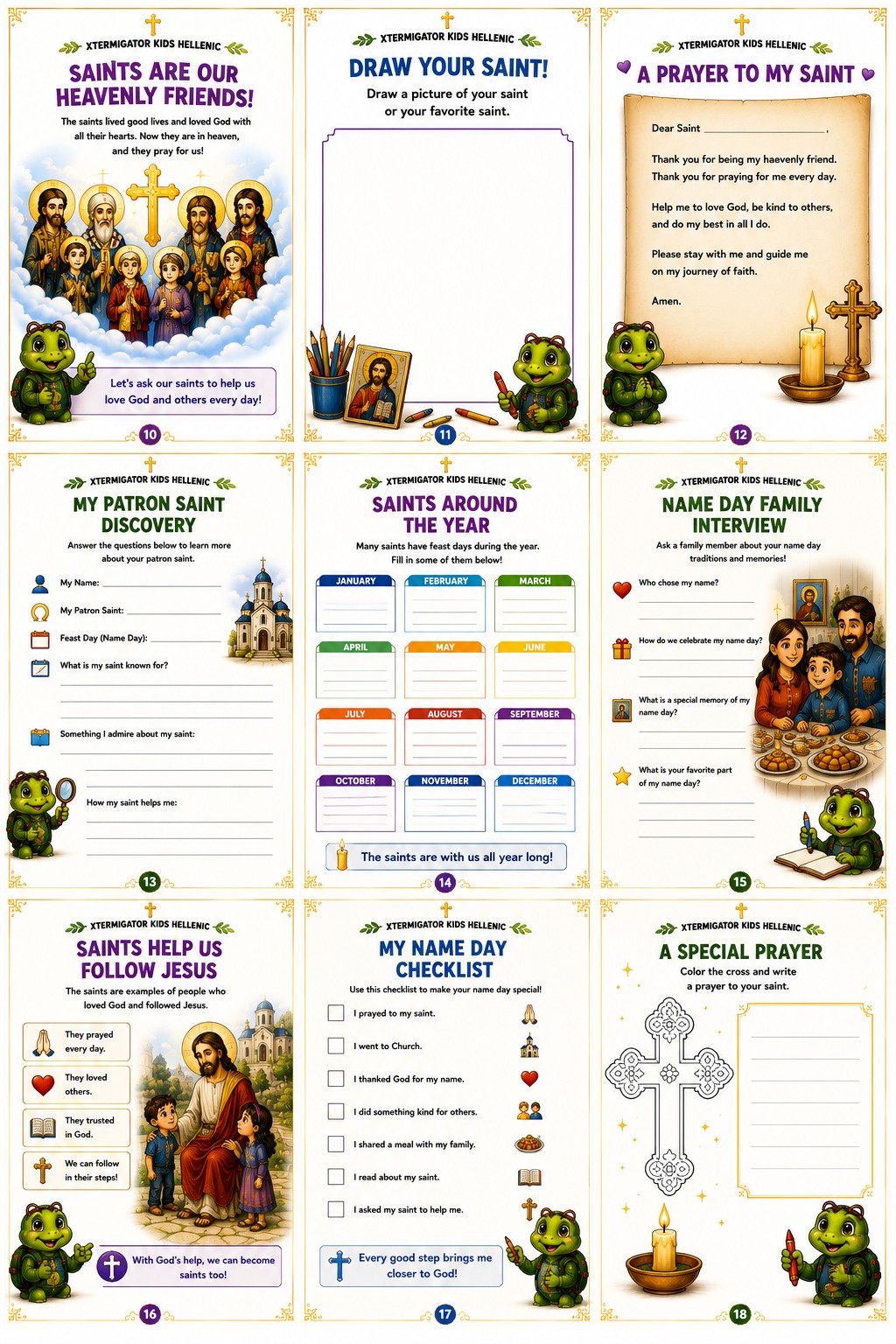
    For children who love stories and visual discovery, the Saints & Name Days curriculum offers activities involving pointing, drawing, listening, prayer, and looking closely at meaningful symbols.

    Purposeful participation can turn “I can’t sit” into “I have a place here.” ⭐

    7. Leaving with grace is still a faithful choice

    Sometimes the movement break, schedule, toolbox, seating change, and job are not enough. Your child may become flooded. You may be exhausted. A sibling may need you. The family may simply reach its limit.

    You are allowed to leave.

    Leaving does not erase the moments you shared. It does not mean the visit was pointless. It does not mean you should never try again.

    A compassionate exit can protect your child’s dignity and preserve your family’s relationship with church. You can say quietly, “Our bodies need to go now. We can try again another day.”

    Try this instead: Leave with grace

    Prepare a simple exit plan with your child and, if possible, with your priest: where to go, who can help, and what happens afterward. You may return to the car, sit somewhere quiet, listen to a prayer, or simply rest.

    No apology tour is required. No public explanation is owed.

    A gentle goodbye is not a failure of faith. It is care. 🤍

    For catechists and parish leaders: Please share this with families

    If you serve in a parish, lead an inclusive Sunday school, or support a special needs ministry church, consider sending this article to parents before a busy season of worship.

    A family may not need another reminder to “prepare better.” They may need to hear:

    • “We are glad you are here.”
    • “You do not have to explain everything.”
    • “We can work together.”
    • “Your child can participate in more than one way.”
    • “You may step out, return, or leave without judgment.”

    The XTERMIGATOR parish inclusion tools offer practical starting points, including a welcome lead, sensory mapping, flexible participation pathways, family partnership, and team preparation.

    Inclusion is not faith-lite. It is a way of making the love already present in Orthodox worship easier to reach.

    A final word for the weary parent

    If today’s church visit lasted ten minutes, those ten minutes mattered.

    If your child only looked at one icon, heard one hymn, lit one candle, received a blessing, or rested safely near you, that mattered.

    If you stayed home because everyone needed rest, that mattered too.

    We are not building faith through pressure. We are building trust through repeated experiences of safety, welcome, prayer, and love. Slowly, gently, together.

    Your child is not too loud, too busy, too sensitive, too tired, too different, or too unsure to belong. Every child belongs in the love of Christ, and your family has a place in the Church. ☦️💛

  • The Proven Inclusion Framework: Notice, Prepare, Welcome, 5 Gentle Steps for Special Needs Church Ministry

    The Proven Inclusion Framework: Notice, Prepare, Welcome, 5 Gentle Steps for Special Needs Church Ministry

    Every child deserves to experience church as a place of safety, belonging, prayer, and joy. For some children, however, the sounds, lights, crowds, transitions, language, or expectations of church and Sunday school can create real barriers to participation.

    That does not mean a child is unwilling, disrespectful, or incapable of learning. It may mean the environment is asking more than their body, brain, or communication system can manage at that moment.

    A thoughtful special needs church ministry does not require a perfect building, a large budget, or a separate program. It begins with a compassionate shift in perspective:

    Instead of asking, “How do we make this child fit?” we ask, “How can we remove barriers so this child can belong?”

    Our five-step framework (Notice, Prepare, Welcome, Partner, and Review) gives clergy, Sunday school teachers, and ministry volunteers a simple way to begin. We can start this Sunday with one family, one classroom, and one conversation. 💛

    1. Notice: Look Beyond Behavior

    Pause, breathe, and ask what the child may be communicating

    The first step in neurodiverse church ministry is noticing what is happening beneath the surface.

    A child who leaves the room, covers their ears, refuses an activity, becomes very quiet, or struggles during transitions may be communicating:

    • “The room is too loud.”
    • “I do not know what will happen next.”
    • “The instructions are hard to understand.”
    • “I am tired, hungry, anxious, or overwhelmed.”
    • “I need a different way to communicate.”
    • “I need movement before I can listen.”
    • “I need a break, not a correction.”

    This does not mean every behavior has one simple explanation. It does mean we can respond with curiosity rather than shame.

    Try a gentle ministry observation

    Before changing everything, walk through the child’s experience from arrival to departure. Notice:

    • Volume, echoes, bells, chanting, or sudden sounds
    • Bright lights, candles, incense, or strong fragrances
    • Crowding at entrances, hallways, or Communion lines
    • Waiting without clear information
    • Fast transitions between activities
    • Instructions given only verbally
    • Seating arrangements that do not allow movement or quiet
    • Activities requiring speech, writing, fine-motor skills, or eye contact

    You can also ask families:

    • “What parts of church feel easiest for your child?”
    • “What moments are usually difficult?”
    • “What helps your child feel safe?”
    • “How does your child show us they need a break?”
    • “What is a comfortable way for them to participate?”

    Families are not visitors to an inclusion plan. They are essential partners in understanding the child.

    A gentle reminder: Behavior is often a message. When we look closer, we find a path toward connection.

    2. Prepare: Make the Path Predictable

    Offer clear information before asking for participation

    Preparation lowers uncertainty. It gives children and families a way to know what is coming before they enter a busy classroom or sanctuary.

    A few practical christian education resources can make a meaningful difference:

    • A picture or written schedule
    • A simple map of the church or classroom
    • A preview of expected sounds, smells, and movements
    • A clearly identified quiet area
    • Flexible seating, including a place near an exit
    • Noise-reducing headphones or other sensory tools
    • A visual “first, then” card
    • Short instructions presented one step at a time
    • A choice of speaking, pointing, drawing, signing, typing, or using AAC

    For Sunday school, a schedule might say:

    1. Welcome
    2. Prayer
    3. Story
    4. Movement break
    5. Choice activity
    6. Closing blessing

    For Divine Liturgy, families may appreciate a child-friendly visual guide showing major moments such as singing, Scripture, incense, processions, Communion, and dismissal.

    The goal is not to make worship mechanical or remove its mystery. The goal is to help children anticipate what is happening so they can participate with greater peace.

    The parish inclusion guide offers practical ideas for visual information, seating choices, quiet spaces, flexible participation, and volunteer preparation.

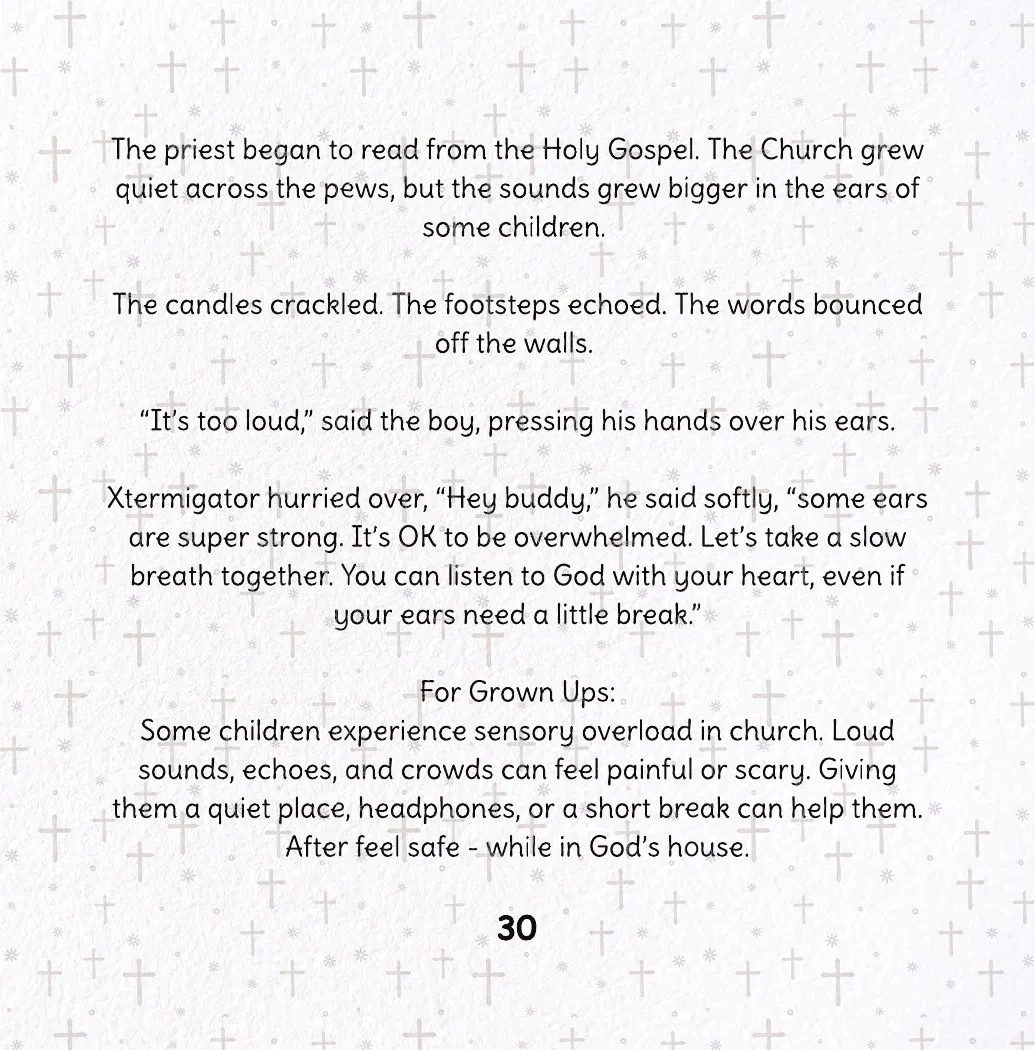
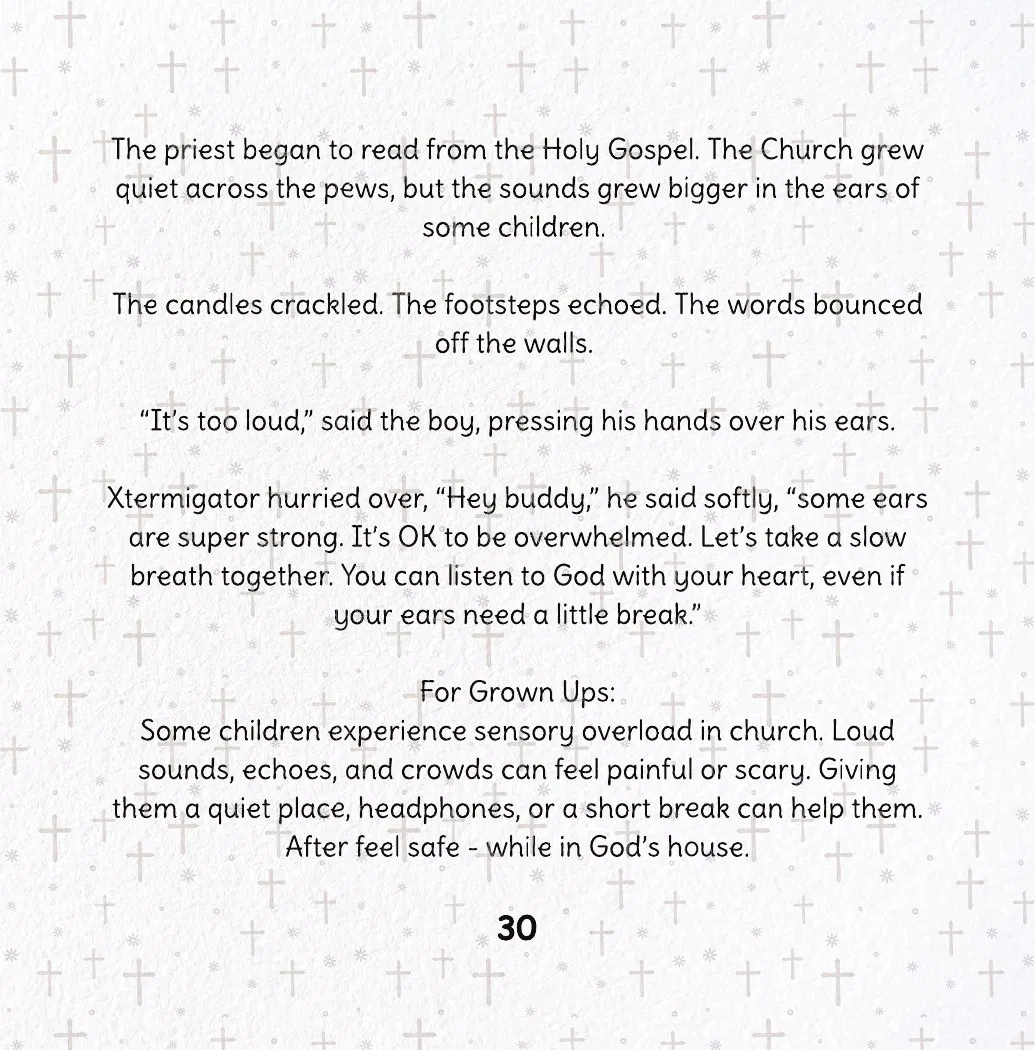
    A gentle illustrated page about sensory overload, loud sounds, and taking a break in church

    Prepare volunteers with simple language

    Volunteers do not need to know every diagnosis or have a perfect response. They do need a calm, respectful plan.

    Teach phrases such as:

    • “It looks like this is hard right now.”
    • “You can take a break.”
    • “Would you like to point or show me?”
    • “First we will sit here, then we can look at the picture.”
    • “You can join in this way.”
    • “You are safe. We can go slowly.”

    Avoid public correction, forced eye contact, or demands that a child “act normal.” A calm voice, fewer words, and extra space can help a child regulate.

    A gentle reminder: Predictability is a form of hospitality. When children know what to expect, they have more room to receive, learn, and pray.

    3. Welcome: Make Belonging Visible

    Say, “We expected you. We are glad you are here.”

    A welcoming ministry does more than permit a family to attend. It communicates that the family is wanted and that the child’s presence strengthens the church community.

    This can begin with the first message, registration form, or conversation:

    “Children with disabilities, sensory sensitivities, communication differences, and different learning styles are welcome here. Please tell us how we can support your family.”

    At arrival, offer a consistent greeting when possible. Show the child where to place belongings, where the class will happen, and what will come first. A familiar volunteer can reduce the stress of entering a new or unpredictable space.

    Welcome also means allowing flexible participation. A child may:

    • Stand, sway, or move quietly
    • Draw while listening
    • Use a fidget or comfort object
    • Wear headphones
    • Step out and return
    • Join only part of an activity
    • Answer by pointing or choosing a picture
    • Watch before participating
    • Participate without speaking

    These are not lower standards. They are different pathways toward engagement.

    Illustrated children learning, praying, helping, celebrating the Divine Liturgy, and loving one another

    In an inclusive Sunday school, we can design lessons with multiple entry points. Children might see a picture, hear a story, touch an object, act out a movement, draw a response, or choose between two options.

    A gentle reminder: Participation is not one shape. Every sincere way of joining is worthy of welcome.

    4. Partner: Honor Family Knowledge

    Replace defensiveness with collaboration

    Families of neurodiverse children are often asked to explain, justify, or defend their child’s needs. A compassionate special needs church ministry changes that experience.

    Instead of beginning with a list of problems, begin with relationship:

    • “What does your child enjoy?”
    • “What helps them feel calm?”
    • “How do they communicate yes, no, more, finished, or help?”
    • “What should we notice before they become overwhelmed?”
    • “What would you like us to do if the room becomes too much?”
    • “How can we contact you respectfully?”

    Write down only what the family wants the ministry team to know, protect privacy, and share information on a need-to-know basis. A brief support plan might include sensory preferences, communication methods, transition supports, medical considerations, and the names of trusted contacts.

    Partnership also means asking the child, when possible. Offer choices rather than assuming:

    • “Quiet corner or hallway?”
    • “Crayons or blocks?”
    • “Listen or draw?”
    • “Sit here or near the door?”

    Choice restores dignity and gives children a meaningful role in their own participation.

    The inclusive lesson planner can support teachers in building visual, hands-on, and flexible options into faith formation.

    A gentle reminder: Families know their children deeply. When we listen together, ministry becomes more humane, practical, and faithful.

    5. Review and Improve: Keep Learning Together

    Choose one small change, then notice what happens

    Inclusion is not a one-time project. It is a practice of listening, trying, reflecting, and improving.

    After a Sunday, ask:

    • What helped the child participate?
    • When did stress begin to rise?
    • Were the instructions clear?
    • Was the quiet space easy to access?
    • Did the family feel respected?
    • What is one small change we can try next time?

    Do not treat a difficult day as failure. A child may be tired, unwell, adjusting to a change, or carrying challenges we cannot see. Review with compassion, not blame.

    A parish team might choose one improvement each month:

    • Add a visual schedule
    • Create a calm corner
    • Train greeters in inclusive language
    • Offer a quiet seating option
    • Preview special services for families
    • Add movement choices to Sunday school
    • Invite feedback after a first visit
    • Include neurodiverse children in meaningful classroom roles

    The parish resources page provides additional practical tools for welcome checklists, family forms, lesson planning, and implementation.

    For faith formation connected to Orthodox tradition, the Saints & Name Days collection offers activities children can approach through reading, listening, pointing, drawing, writing, praying, or talking with a trusted adult.

    Children exploring Orthodox saints, name days, prayer, drawing, and faith-filled activities

    A gentle reminder: Small improvements, repeated with love, become a culture of belonging.

    Start This Sunday: One Family, One Classroom, One Conversation

    We do not have to solve every barrier before we begin. We can start gently:

    1. Notice one moment that may be communicating stress.
    2. Prepare one visual, sensory, or transition support.
    3. Welcome one child with a clear choice.
    4. Partner with one family conversation.
    5. Review what helped and choose the next small step.

    A parish that practices these steps makes room for children to learn, worship, move, communicate, rest, and return without shame.

    That is the heart of inclusive Sunday school and faithful neurodiverse church ministry: not changing the love of the Church, but removing barriers that keep children from experiencing it.

    Different is beautiful. Every child belongs. Together, we can build a church where every family can pause, breathe, listen, and come home. 💜

    Further Reading

  • Struggling to Keep Kids Calm at Divine Liturgy? 25 Quiet-Church Toolbox Ideas

    Struggling to Keep Kids Calm at Divine Liturgy? 25 Quiet-Church Toolbox Ideas

    If Divine Liturgy sometimes feels loud, long, crowded, or unpredictable for your child, you are not alone. Many families are looking for gentle ways to support children with sensory sensitivities, autism, ADHD, anxiety, or communication differences during worship.

    Most importantly: your child does not have to be perfectly still or perfectly quiet to belong in church. Children belong in the life of the Church as they are. A wiggle, a movement break, a quiet tool, or a brief step into the hallway does not erase their participation.

    The goal is not to make a child disappear. The goal is to offer concrete support so they can connect, listen, pray, observe, move, and return in ways that are possible for them.

    This quiet-church toolbox is a starting point for Orthodox Christian parenting, special needs ministry church planning, and inclusive Sunday school support. Choose only what feels helpful. Every item is an invitation, not a requirement. 💛

    “Different is beautiful. Every child belongs.”

    First, Let’s Change the Question 🌿

    Instead of asking, “How do we make our child stay quiet for the whole service?” we can ask:

    • What sounds, sights, or transitions may feel difficult?
    • What helps our child feel safe and oriented?
    • Where can our child participate through pointing, speaking, moving, drawing, or watching?
    • What can our parish change so welcome is more than a kind word?

    The Orthodox Church in America’s guidance on children and the Divine Liturgy recognizes that children need age-appropriate support, visual connection, movement, and gentle practice. It also reminds us that parish customs differ, so families should speak with their priest about local expectations.

    Phase 1: Notice and Prepare Before Church 🕯️

    A little preparation can soften the unknown. We can pause, breathe, and look closer at what our child may need before we walk through the doors.

    1. Create a small church-only bag

    Use a simple pouch or tote that comes out only for Divine Liturgy. A predictable bag can become a reassuring signal: We know what is happening next, and we have support.

    Keep it light. A few useful items are better than a crowded bag.

    2. Add child-sized headphones or ear defenders

    Some children experience bells, chanting, crowded greetings, or echoing voices as physically uncomfortable. Child-sized headphones or ear defenders can reduce sound intensity while still allowing a child to remain connected.

    Check that your child can hear important safety directions. If your parish has specific guidance about headphones, ask kindly in advance.

    3. Pack one quiet fidget

    Choose a silent, soft, or minimally distracting fidget: a smooth stone, fabric loop, quiet sensory ring, or small squishy item.

    The purpose is not entertainment. Rhythmic hand movement may help a child listen with their whole body.

    4. Bring a comfort object

    A small stuffed animal, scarf, prayer cross, or familiar object can provide grounding during an unfamiliar moment.

    A comfort object is not a sign that a child is too old for worship. Sometimes holding something familiar helps us feel safe enough to participate.

    5. Prepare a visual guide to the Liturgy

    A picture-based guide can show major moments such as:

    1. Gathering and opening prayers
    2. Little Entrance
    3. Scripture readings and sermon
    4. Great Entrance
    5. Creed
    6. Lord’s Prayer
    7. Communion
    8. Dismissal and fellowship

    Your child might point to “now” or turn over one card at a time. A visual guide is a bridge to understanding, not a demand to follow every step perfectly.

    6. Pre-teach bells, incense, and processions

    Before Sunday, show a picture or describe what your child may notice:

    • “The bells may sound suddenly.”
    • “Incense may create a strong smell.”
    • “People may walk in a procession.”
    • “The priest may carry the Gospel or the Holy Gifts.”
    • “Many people may stand, cross themselves, or bow.”

    Use calm, honest language. We do not need to say, “There is nothing to worry about.” We can say, “That sound may feel big. We will be together, and you can use your headphones.”

    7. Practice a gentle breathing prompt

    Try a simple rhythm at home:

    Breathe in for 3. Breathe out for 4.

    We can quietly say, “In-2-3. Out-2-3-4.” Practice when your child is already calm, so it feels familiar when stress rises.

    8. Choose a low-stimulation seating area

    Consider where your child can best see and feel secure. Some children benefit from sitting near the front, where the actions are easier to observe. Others need an aisle seat, a back corner, or a place near an exit.

    There is no universally correct seat. The best seat is the one that supports connection and safety.

    9. Agree on a break signal

    Choose a gesture, picture, or short phrase your child can use to communicate, “I need a break.”

    A child may point to a break card, touch their ear, raise a hand, or whisper, “Hallway.” Communication does not have to be verbal to be meaningful.

    10. Tell the priest or catechist ahead of time

    A brief conversation can prevent confusion:

    “Our child may use headphones, move quietly, or step out and return. We are helping them participate with support.”

    This is a practical part of a special needs ministry church, not a special favor. Parish leaders can help identify a quiet room, a safe walking route, or a trusted adult.

    Illustrated child experiencing sensory overload and receiving gentle support

    Phase 2: Welcome Participation During Liturgy ✨

    Participation can look different from child to child. One child may sing. Another may watch. Another may draw an icon, stand beside a parent, or gently move near the back.

    11. Use a small drawing pad

    A small drawing pad and a few crayons can give busy hands a peaceful focus. Invite your child to draw:

    • The cross
    • An icon
    • A candle
    • The church building
    • Something they heard
    • Someone they want to pray for

    Drawing can be a form of attention. It should remain a gentle choice, not a task to complete.

    12. Offer a picture prayer card

    A picture prayer card might show a heart, cross, candle, family, or person in need of prayer. Your child can point to an image, trace a symbol, or hold the card during prayer.

    For children who communicate without speech, this creates a meaningful way to join in.

    13. Use a quiet prayer list

    Invite your child to draw or write names, people who are sick, pets, friends, or things they are thankful for. A simple list can turn waiting time into loving attention.

    There is no need to correct spelling or handwriting. The prayer is the offering.

    14. Give one quiet object to hold

    A small cross, icon card, prayer rope, or soft fabric square may help a child keep their hands grounded.

    Teach gentle handling beforehand. The object should support reverence without becoming another source of pressure.

    15. Point out what is happening

    Use a whisper or a visual card:

    • “The Gospel is being read.”
    • “The choir is singing.”
    • “The priest is carrying the gifts.”
    • “Now we are praying together.”

    Short explanations are often more helpful than long lessons. We can simply notice, pause, breathe, and listen.

    16. Build in movement

    Some children regulate through movement. A quiet walk near the back, standing beside a parent, stretching hands, rocking gently, or shifting from sitting to standing may help.

    Movement is not automatically disrespectful. With guidance and care, it can help a child remain connected to worship.

    17. Use a “focus moment” card

    A visual card can show when the family will pause tools and look together. Choose only a few moments at first, such as the Gospel, Great Entrance, Creed, or Lord’s Prayer.

    A child does not need to focus intensely for the entire service to have a meaningful experience.

    18. Offer a calm sensory reset

    If your child becomes overwhelmed, try reducing language and stimulation:

    • Lower your voice.
    • Move to a less crowded spot.
    • Offer headphones.
    • Let them hold their comfort object.
    • Breathe together.
    • Wait before asking questions.

    Calm first. Teaching can come later.

    19. Keep the toolbox flexible

    What helps one Sunday may not help the next. Sleep, illness, hunger, changes in routine, weather, crowds, and unfamiliar visitors can all affect regulation.

    Flexibility is not inconsistency. It is responsive care.

    20. Remember that children are not required to be quiet to belong

    A child may vocalize, flap, hum, sway, or need extra movement. We should distinguish between intentional disruption and a nervous system communicating a need.

    Gentle support asks, “What is this behavior telling us?” before it asks, “How do we stop it?”

    “We do not have to earn our place in the house of God.”

    Phase 3: Plan a Dignified Exit and Return 🤍

    Stepping out is not failure. Returning is not a test. Leaving briefly and coming back is participation with support.

    21. Create a simple exit plan

    Before Liturgy, explain:

    “If the church feels too big, we will walk out together. We will find a calm place, breathe, and decide what comes next.”

    Keep the route predictable. Know where the hallway, narthex, restroom, or quiet room is located.

    22. Use a break card

    A card might say:

    I need a quiet break. I will come back when my body is ready.

    The card can be shown to a parent, priest, catechist, or ministry volunteer. It gives a child a dignified communication tool without requiring a long explanation.

    23. Reduce shame during the exit

    Avoid announcing, scolding, or treating the break like punishment. Use neutral language:

    “Your body needs less sound. We are going to take care of you.”

    A calm exit protects the child’s dignity and helps the wider community remain peaceful.

    24. Decide whether and when to return

    After a short break, offer choices:

    • “Would you like to come back now?”
    • “Would you like headphones?”
    • “Would you like to stand near the door?”
    • “Would you like to watch from the narthex?”
    • “Would you like to go home today?”

    Safety and regulation come first. Returning is welcome, but it is never something to force.

    25. Celebrate connection, not performance

    After church, avoid asking, “Were you good?” Try:

    • “What felt comfortable today?”
    • “What felt too loud?”
    • “What helped your body?”
    • “What would you like to bring next Sunday?”
    • “Did you notice anything beautiful?”

    The goal is not a perfect service. The goal is a growing relationship with worship, community, and God.

    Children learning prayer through an Orthodox prayer book

    How Parishes Can Make This Easier 🌟

    Families should not have to solve inclusion alone. Parish leaders, priests, catechists, and volunteers can take small, ready-to-use steps:

    • Create a quiet corner or calm room.
    • Offer visual schedules of the Liturgy.
    • Train greeters to welcome families without judgment.
    • Share sensory information about bells, incense, and crowds.
    • Keep a few quiet church tools available.
    • Invite parents to explain what support is helpful.
    • Make inclusive Sunday school flexible, visual, and choice-based.
    • Welcome children who need to move, draw, point, speak, or step out.

    Our parish inclusion tools are designed to help communities move from good intentions to practical support. Families may also appreciate connecting visual faith formation with our Saints and Name Days resources.

    For additional Orthodox context on children and worship, read the Orthodox Church in America’s guidance on children and the Divine Liturgy. Parish practices vary, so always coordinate with your own priest or ministry leader.

    A Gentle Sunday Checklist 🕊️

    Before leaving home, choose only a few:

    • ☐ Headphones or ear defenders
    • ☐ One quiet fidget
    • ☐ Comfort object
    • ☐ Visual Liturgy guide
    • ☐ Drawing pad and a few crayons
    • ☐ Picture prayer card
    • ☐ Break card
    • ☐ Water or medical supports as appropriate
    • ☐ A planned low-stimulation seat
    • ☐ A dignified exit-and-return plan

    You do not need every tool. You do not need a perfect morning. You are allowed to adjust, pause, breathe, and begin again.

    Children belong in the Church, not because they can perform calmness, but because they are beloved members of the Body of Christ. With practical supports and compassionate community, Divine Liturgy can become a place where every child is invited to participate in a way that honors their body, communication, and unique gifts.

    Pause. Breathe. Listen. There is room for you here. 💛

    Children and families gathered together as a welcoming Orthodox church community

  • Top 10 Inclusive Sunday School Ideas for Orthodox Parishes, No Budget, No Fancy Equipment

    Top 10 Inclusive Sunday School Ideas for Orthodox Parishes, No Budget, No Fancy Equipment

    A more inclusive Sunday School does not have to begin with a new building, a large budget, or specialized equipment. Often, it begins with a handwritten picture, a welcoming face, a flexible chair, or one trusted adult who knows how to say, “You belong here.”

    For Orthodox parishes welcoming children with autism, ADHD, sensory sensitivities, communication differences, or other support needs, small changes can make faith formation more predictable and accessible. These ideas use supplies your parish likely already has: bulletins, paper, crayons, pillows, baskets, icons, chairs, and willing people.

    The goal is not perfect participation. The goal is belonging.

    Together, we can use practical christian education resources, religious education resources, and compassionate special needs ministry church practices to make inclusive Sunday school possible this Sunday.

    Begin with three gentle steps: Notice, Prepare, Welcome

    Before choosing an idea, pause and consider the child’s experience.

    1. Notice: What might be difficult, the noise, waiting, transitions, lighting, touch, or uncertainty?
    2. Prepare: What simple support could make the next step clearer?
    3. Welcome: How can we offer choice without pressure?

    Every child may participate differently from week to week. A child might listen today, draw next Sunday, and need a quiet break the week after. None of these choices is a failure.

    A gentle parish does not ask, “Why can’t this child participate?” We ask, “What pathway might help this child belong?”

    1. Draw a picture schedule on the back of a bulletin

    Make the morning easier to understand

    Use the back of an old bulletin, a sheet of scrap paper, or a small whiteboard. Draw five simple pictures showing the order of class:

    Prayer → Story → Activity → Snack → Goodbye

    The drawings do not need to be artistic. A heart can represent prayer. An open book can represent the story. A crayon can represent the activity.

    Point to the schedule as you move through the lesson. Cross off or turn over each step when it is finished.

    This simple visual cue helps children know what is happening now and what comes next. It can also support children who communicate better through pictures than spoken instructions.

    Try it this Sunday: Ask one volunteer to draw the schedule before children arrive.

    2. Create a pillow-and-basket quiet corner

    Offer a calm place without sending anyone away

    Choose a corner of the classroom and add a pillow, an empty basket, and perhaps a familiar icon or soft cloth. The space does not need to be hidden or labeled as a place for “misbehavior.” It is simply another way to participate.

    The basket might hold:

    • A folded bulletin
    • A soft piece of fabric
    • A paper and crayon
    • A small book
    • A quiet fidget already available in the classroom

    A child may sit there for a moment, pray quietly, look at a picture, or return to the group when ready. Adults can model this by saying, “We can pause, breathe, and come back when our bodies are ready.”

    A child-friendly quiet church toolbox offering practical sensory supports for worship

    If your parish is ready for additional support, our parish inclusion resources include practical guidance for quiet spaces, visual information, flexible participation, and family partnership.

    A quiet corner is not an exit from community. It is a bridge back to belonging.

    3. Give every child a helpful classroom job

    Make belonging visible through meaningful responsibility

    Children do not need to sit perfectly still to be part of the lesson. Offer a simple helper job, such as:

    • Holding the picture schedule
    • Passing out crayons
    • Carrying the storybook
    • Turning a page
    • Placing an icon or picture on the table
    • Collecting papers
    • Choosing the closing song

    Show the job with a picture or demonstrate it once. A child may accept the job, decline it, or try it for only a short time. Each response is okay.

    A helper role can support movement, communication, confidence, and connection without requiring a child to speak in front of the group.

    4. Use a picture-based prayer card

    Make prayer accessible through seeing, pointing, and choosing

    Write a short prayer on a piece of paper and add simple drawings beside key words. For example:

    • A heart for love
    • Hands together for pray
    • A family for home
    • A cross for Christ
    • A sun or star for hope

    Invite children to point to a picture, repeat one word, trace a symbol, or simply look at the card while the teacher prays.

    You can also offer two choices: “Would you like the prayer with the heart picture or the cross picture?” Choice turns prayer into an invitation rather than a performance.

    For lessons connected to saints and feast days, our Saints & Name Days resources offer visual, printable activities that children can approach by reading, listening, pointing, drawing, writing, praying, or talking with a trusted adult.

    5. Make a “break” card

    Give children a respectful way to communicate “I need a moment”

    Cut a small rectangle from scrap paper. Write BREAK in large letters and draw a simple pause symbol or a child sitting quietly.

    Explain the card to the whole class, not just to one child:

    “Anyone may use this card when they need a short pause. You can show it, point to it, or ask an adult.”

    Place the card where children can reach it. When a child uses it, respond calmly: “Thank you for telling me. Let’s find a comfortable place.”

    A break is not a reward and does not need to be earned. It is a communication support. Children may need a break because of noise, crowded movement, strong emotions, fatigue, or difficulty processing several instructions at once.

    6. Offer more than one way to respond

    Let children point, draw, move, or speak

    After telling a Bible story or saint’s story, avoid making spoken answers the only option. Ask children to choose how they would like to respond:

    • Point to a picture
    • Draw a favorite part
    • Move like a character in the story
    • Speak an answer
    • Write a word
    • Choose between two pictures
    • Use a communication device or gesture

    For example, after a lesson about courage, one child might say, “Brave.” Another might draw a shield. Another might point to Saint George. Another might quietly act out standing tall.

    The learning is still real. The response simply looks different.

    7. Plan a movement break between activities

    Use purposeful movement instead of expecting long stillness

    Place a one- or two-minute movement break between the story and the activity. Invite children to:

    • Stretch their arms like a cross
    • Walk quietly to place a picture on the wall
    • Carry books to a table
    • Act out a journey from a saint’s story
    • Stand, breathe, and shake out their hands
    • Follow a simple “reach, bend, pause” pattern

    Movement can help children transition and may support attention for the next part of the lesson. It does not need to become a noisy game.

    Say, “We are going to move gently, then return to our places.” Some children may participate fully, some partially, and some may watch. Watching is also a valid choice.

    8. Assign a designated greeter who knows the family

    Replace uncertainty with one familiar welcome

    Choose one teacher, usher, or parish volunteer to serve as a consistent contact for a family. The greeter can learn:

    • The child’s name and preferred communication style
    • What helps during transitions
    • Where the family prefers to sit
    • How the child communicates “yes,” “no,” or “break”
    • Who the parent wants contacted if support is needed

    The greeter should never demand personal information in public. A quiet conversation with the family is enough. Families are experts on their children, and their knowledge should guide the parish’s support.

    The TEAM Belong Eastern Orthodox workbook emphasizes moving beyond simple presence toward being invited, welcomed, known, supported, needed, and loved. A consistent greeter is one small way to begin that journey.

    9. Walk through the church before the service

    Make unfamiliar moments more predictable

    Before Divine Liturgy, Sunday School, or a feast-day service, offer a brief walk-through for a child and family. Visit the places they may encounter:

    • The entrance
    • The classroom
    • The worship space
    • The restroom
    • The quiet area
    • The candle stand
    • The location of the priest, choir, or procession

    Use simple language: “This is where we enter. This is where the singing happens. The incense may smell strong here. You can step outside with your grown-up if you need to.”

    A walk-through does not need to be formal. Even five calm minutes can help a child look closer, ask questions, and know what to expect.

    For broader parish planning, the GOARCH Church School resources can complement your local approach to Orthodox religious education.

    10. Build an inclusive lesson from ordinary supplies

    Turn what you already have into a flexible faith adventure

    Choose one story, icon, saint, or feast day. Then gather paper, crayons, chairs, a blanket, or a few classroom objects.

    You might:

    • Use chairs to create a simple path
    • Use a blanket as a boat, road, or tent
    • Invite children to place picture cards in story order
    • Create a shared class drawing
    • Let children dictate a sentence for an adult to write
    • Use objects to represent people or places in the story
    • End with a choice of prayer, song, drawing, or quiet reflection

    Our Saints & Name Days printable collection is designed for flexible use at home, in Sunday School, or in a parish calm space. Children can explore a saint’s life through visual prompts, family traditions, prayer, and creative choices.

    Children learning about Orthodox saints and feast-day traditions through visual activities

    A simple Sunday checklist ✦

    Before class begins, ask:

    • Is there a picture schedule?
    • Is there a place for a quiet break?
    • Is one adult ready to welcome and listen?
    • Can children respond in more than one way?
    • Is a movement break built into the lesson?
    • Does the family know what to expect?
    • Have we removed pressure wherever possible?

    You do not need to do everything at once. Choose one idea, notice what helps, and build from there.

    Every child belongs in the story

    Inclusive Sunday School is not a special program reserved for a few children. It is a way of shaping parish life so that more children can see themselves as active members of the Body of Christ.

    Begin with what is already in your hands: a bulletin, a pillow, a basket, a crayon, a picture, a patient adult, and a willingness to listen.

    Pause. Breathe. Welcome.

    Different ways of participating can still lead us together toward prayer, learning, friendship, and Christ.

    A joyful Orthodox Christian community learning, praying, and caring for one another

  • How to Create a Sensory-Friendly Sunday School Space in 5 Minutes (Before the Bell Rings)

    How to Create a Sensory-Friendly Sunday School Space in 5 Minutes (Before the Bell Rings)

    The room is almost ready. The lesson is printed, or nearly printed. Children will arrive soon.

    You may have only five minutes to make your Sunday School classroom feel calmer, clearer, and more welcoming. That is enough time to make a meaningful difference.

    A sensory-friendly Sunday School does not require a complete renovation, a large budget, or specialized training. It begins with small, thoughtful choices that help children know what to expect and how they may participate.

    These adjustments can support autistic children, children with ADHD, children with sensory sensitivities, children who communicate differently, and any child who feels more secure when the environment is predictable.

    Most importantly, sensory-friendly does not mean faith-lite. Orthodox tradition stays intact. We are simply removing unnecessary barriers so more children can listen, wonder, pray, learn, and belong.

    A calmer classroom can make more room for a child’s faith, curiosity, and joy. 💛

    Your five-minute welcome plan

    Think of this as a quick, repeatable routine:

    1. Soften the room
    2. Create one quiet option
    3. Show what will happen
    4. Offer choices
    5. Welcome each child gently

    You do not need to do everything perfectly. Choose the changes that are possible today, then build from there.


    Minute 1: Soften harsh light and unnecessary noise 💡

    Begin with the senses that children notice immediately: light and sound.

    If the overhead lights are bright or buzzing, turn off some of them if possible. Use natural light, a lamp, or a softer light source instead. You can also close part of the blinds if strong sunlight creates glare.

    Next, take a quick look at the room’s sound level:

    • Turn off background music before class begins.
    • Silence notifications on phones or tablets.
    • Close a door if hallway noise is distracting.
    • Avoid starting class with sudden loud sounds.
    • Let children know before using music, bells, or other louder materials.

    This does not mean the classroom must be silent. Many children enjoy music, singing, and movement. The goal is to make sound intentional rather than constant and surprising.

    If your Sunday School curriculum includes a song or activity with louder sounds, offer a simple preview: “We will sing in a moment. You may sing, make the motions, listen, or take a quiet break.”

    That one sentence gives children information and autonomy.

    Pause, breathe, listen. A gentle beginning helps every child arrive. ✨


    Minute 2: Designate a quiet corner 🪑

    You do not need a separate sensory room to create a quiet option. Use one corner of the classroom, a space near the wall, or an area away from the busiest walkway.

    Place one or two calming items there:

    • A floor cushion or small chair
    • A soft blanket
    • A few board books
    • Noise-reducing headphones
    • A small stuffed animal
    • A simple drawing pad
    • A “break” card or picture symbol

    Add a friendly sign such as:

    Quiet Corner: You are welcome to rest here.

    The quiet corner is not a punishment space, and it should never be presented as a place where children are sent for “bad behavior.” It is a regulation option. A child may use it for a few minutes and return when ready, or participate from there if that works better.

    Keep the pathway clear so children can reach the space without climbing over bags or asking for public permission. If supervision is needed, establish a calm plan with your ministry team before class begins.

    For additional parish-wide ideas, explore our parish inclusion resources for clergy, educators, and ministry teams.

    A break is not a failure to participate. A break is one way a child remains connected. 🌿

    A calm classroom doorway with a welcoming catechist, visual schedule, break card, and sensory tool basket


    Minute 3: Put up a simple visual schedule 👀

    Transitions can feel difficult when children do not know what is coming next. A visual schedule makes the shape of the lesson visible.

    Write or draw five or six steps on a small whiteboard, paper, or card strip:

    1. Welcome
    2. Prayer
    3. Bible or saint story
    4. Activity
    5. Movement or quiet choice
    6. Goodbye

    Use pictures, objects, written words, or a combination. The schedule does not need to be beautiful. It needs to be easy to understand.

    Point to each step as you move through the lesson. Before a transition, give a gentle warning:

    • “Two more minutes, then we will clean up.”
    • “The story is ending. The activity comes next.”
    • “After prayer, you may choose drawing or building.”

    If the plan changes, show the change whenever possible. You might cross out one picture, move a card, or say, “The order is different today. We will do music after the story.”

    For children who do not use speech, a visual schedule can communicate without requiring an explanation. For children who do use speech, it can still reduce uncertainty and support independence.

    Our Saints and Name Days activities offer examples of visual, flexible faith formation that can be used at home, in Sunday School, or in a parish calm space.

    Orthodox Saints and Name Days learning pages designed for visual and flexible participation


    Minute 4: Offer seating and participation choices 🧡

    There is no single “right” way for every child to sit and learn.

    Before the children arrive, make two or three seating options available:

    • A regular chair
    • A floor cushion
    • A seat near the door
    • A place at the edge of the group
    • A standing space at the back
    • A wiggle cushion, if your parish has one

    Keep walkways open, especially toward the quiet corner and the exit. Some children focus better when they can move, stand, or sit slightly apart from the group.

    You can also offer choices in how children participate:

    • Point to a picture
    • Repeat a phrase
    • Draw an answer
    • Build something
    • Use a communication device
    • Sign or gesture
    • Listen quietly
    • Speak with a trusted adult
    • Watch from the quiet corner

    Choice-based participation is especially helpful in an inclusive Sunday School because it communicates that children do not have to perform faith in one particular way.

    A child who is listening while moving is still listening. A child who draws during the story may be deeply engaged. A child who does not answer aloud may still understand and love what they are learning.

    We make space for every child to point, speak, move, draw, listen, and wonder. ⭐


    Minute 5: Set out one sensory tool basket 🧺

    You do not need a large collection of specialized equipment. Begin with one small basket that children may access with guidance.

    Possible items include:

    • Soft stress balls
    • Textured fidgets
    • Smooth stones
    • Pipe cleaners
    • Small fabric squares
    • Simple coloring tools
    • Ear defenders or headphones
    • A visual break card

    Introduce the basket to the whole class without singling out a particular child:

    “These tools help some people listen and feel comfortable. You may choose one, or you may choose none.”

    Set a few clear expectations:

    • Tools are for helping bodies focus and feel safe.
    • Tools stay quiet and do not hurt people.
    • Children may return an item if it is not helpful.
    • A child may request a different support or a break.

    If a tool becomes distracting, redirect gently: “That item is not helping right now. Would you like to try another one or take a quiet moment?”

    Whenever possible, avoid taking a sensory tool away as a punishment. The purpose is support, not compliance.

    A sensory-friendly Orthodox Sunday School activity where children participate through drawing, pointing, listening, movement, and quiet reflection


    Add a calming greeting at the door 🚪

    The first few seconds matter.

    Instead of calling out instructions from across the room, greet each child with a calm, predictable invitation:

    • “I’m glad you’re here.”
    • “You can choose a seat.”
    • “Here is our schedule.”
    • “You may start with drawing or looking at a book.”
    • “It is okay to take your time.”

    Some children may want a wave. Others may prefer no touch, no eye contact, or extra physical space. Let the child’s response guide you.

    A visual greeting card can help:

    • Wave
    • Smile
    • Fist bump
    • Quiet hello
    • No greeting right now

    The goal is not to make every child respond in the same way. The goal is to communicate: You are safe here. You belong here.

    A welcoming arrival can also help caregivers feel more comfortable sharing useful information. Invite families to tell you what helps, what to notice, and how their child communicates a need for a break. Families know their children best, and partnership strengthens special needs church ministry.


    Remember: small changes are real inclusion 🌟

    You may not be able to change every light, purchase every sensory tool, or create a dedicated room this week. That is okay.

    Start with:

    • One softer light
    • One quiet corner
    • One visual schedule
    • One seating choice
    • One sensory basket
    • One break card
    • One compassionate greeting

    These are concrete tools for real classrooms, not abstract ideals. They can be prepared before the bell, used during a busy lesson, and improved over time with feedback from children and families.

    As your parish grows, you may add volunteer training, a sensory map, visual guides for the Divine Liturgy, family forms, or a parish-wide inclusion plan. Our church inclusion guide can help your team think through predictable information, flexible participation, quiet areas, and family partnership.

    The Orthodox faith remains rich, beautiful, and whole. We are not removing the story, the prayer, the saints, the feast days, or the tradition. We are making more paths into them.

    Different is beautiful. Every child belongs. Together, we can make welcome visible. 💛

    A small sensory-friendly church toolbox with practical tools to help children participate comfortably

    A five-minute checklist for Sunday School teachers

    Before the children arrive, ask:

    • Can I soften one bright light or reduce glare?
    • Is there a quiet place where a child may take a break?
    • Can children see what will happen next?
    • Are there at least two seating choices?
    • Is one small basket of sensory tools available?
    • Do children have a way to request a break without speaking?
    • Can I greet each child without pressure?

    You do not have to complete every box. Choose one today. Then notice what helps.

    One small adjustment can become a doorway to belonging.

  • Coming Soon: The Missing Leaf Mystery, A New Xtermigator Swamp Adventure

    Coming Soon: The Missing Leaf Mystery, A New Xtermigator Swamp Adventure

    Something curious is taking place in the swamp. 🐊🍃

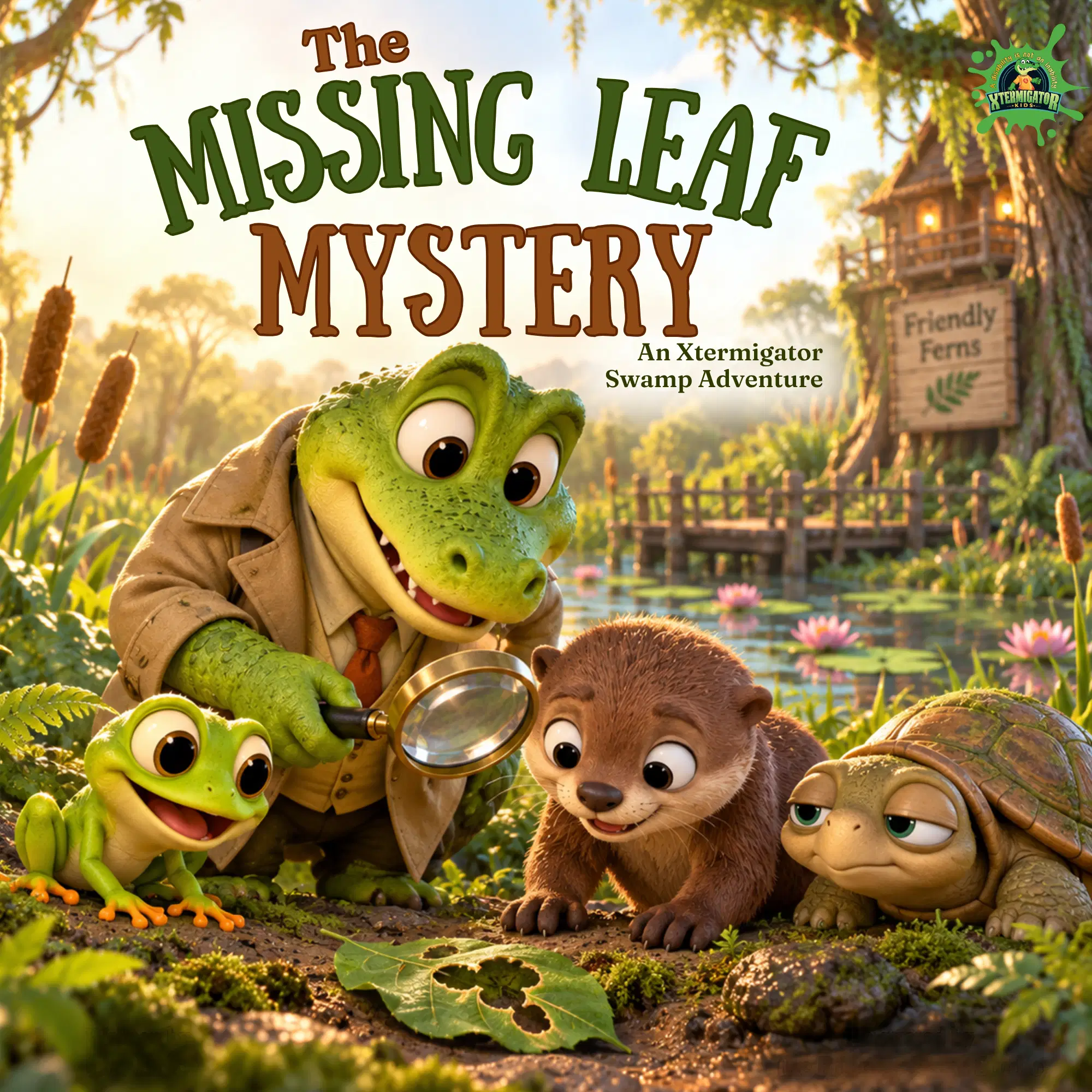
    We are delighted to reveal the cover of an upcoming children’s book: The Missing Leaf Mystery, An Xtermigator Swamp Adventure.

    This is a coming soon announcement, not a purchase announcement. The book is not available yet, and we are not sharing a release date or preorder information at this time. For now, we are simply inviting families, educators, and friends of Xtermigator Kids to look closely, enjoy the cover, and stay tuned for what is ahead.

    A Gentle Mystery Begins in the Swamp 🔍

    The cover introduces a warm, playful scene filled with gentle curiosity.

    At the center, Xtermigator wears a detective coat and holds a magnifying glass while examining a chewed leaf. Nearby, a frog, an otter, and a turtle have gathered to look more closely. Together, the friends seem ready to notice small clues, share observations, and wonder about what may have happened.

    The setting is a lush swamp, with greenery, water, and a welcoming sign for Friendly Ferns in the background. The colors and expressions create an inviting atmosphere rather than a frightening one. This is a mystery that feels approachable: a chance to pause, look closer, and enjoy the fun of wondering together.

    We are not sharing plot details yet. The cover gives us a first glimpse of the world, the characters, and the gentle mystery at its center. Sometimes, the best beginning is a single question:

    Where did the missing leaf go?

    Every good adventure can begin with a curious heart and a gentle question. 💛

    Why We Love This Kind of Storytelling

    Children’s stories can offer more than a sequence of events. They can create space for observation, communication, imagination, and connection.

    A mystery invites children to notice details at their own pace. One child may study the pictures. Another may point to a clue, make a guess, act out a character, or simply listen while someone else shares an idea. There is no single “right” way to participate.

    That matters deeply to us.

    At XTERMIGATOR Kids Hellenic, we believe children deserve resources that welcome different ways of thinking, communicating, moving, and engaging. A child may speak, point, draw, gesture, use a communication device, or take a quiet pause. Each way of joining is meaningful.

    As we look toward this new Xtermigator swamp adventure, we are holding onto that same spirit of belonging: curiosity without pressure, participation without comparison, and stories that leave room for every child.

    A New Adventure for Families to Discover Together 🌿

    When The Missing Leaf Mystery becomes available, families will be able to approach it in a way that feels comfortable for them.

    You might:

    1. Look at the cover together.
      Pause, breathe, and notice the characters, colors, setting, and leaf. Ask, “What do you see?”- or simply enjoy the picture without questions.

    2. Let curiosity lead.
      Invite your child to make a guess, point to a character, draw what they think happened, or choose a favorite part of the scene.

    3. Follow your child’s communication style.
      Some children may want to talk through every possibility. Others may prefer listening, moving, or looking quietly. Each choice is welcome.

    4. Make room for pauses.
      A mystery does not need to be solved all at once. We can stop and return later, take a movement break, or let the story unfold slowly.

    5. Celebrate connection rather than correctness.
      The goal is not to guess perfectly. The goal is to wonder together.

    These gentle approaches can be helpful for families practicing Orthodox Christian parenting, Sunday school teachers preparing inclusive activities, and parish leaders who want children’s resources to offer flexibility rather than pressure.

    There is room in every story for the child who speaks, the child who listens, the child who moves, and the child who notices quietly. ⭐

    Stories That Support Belonging

    Our wider work focuses on inclusive Orthodox Christian faith formation for children and families. We create practical tools that help make faith experiences more accessible, welcoming, and flexible for children with sensory sensitivities, autism, ADHD, communication differences, and many other ways of experiencing the world.

    That mission includes visual storybooks, interactive faith adventures, sensory-friendly worship supports, movement breaks, communication supports, and parish inclusion tools.

    Xtermigator Kids logo representing inclusive educational resources and belonging

    We know that families may be searching for orthodox children books that feel warm, visually engaging, and respectful of each child’s needs. We also know that catechists and ministry leaders need more than encouraging words. They need concrete Christian education resources they can use in real classrooms, parish spaces, and homes.

    Our goal is to help build those resources with care.

    Whether a child is exploring an Orthodox feast day, learning about a saint, preparing for Divine Liturgy, or enjoying a gentle story adventure, participation can remain flexible. Children can point, speak, move, draw, observe, or take a break. Different is beautiful, and every child belongs in the faith community.

    Connecting Stories with Orthodox Faith Formation ✝️

    The Missing Leaf Mystery is an upcoming Xtermigator adventure. As we continue developing and sharing resources, we also invite families and educators to explore the faith-formation tools already available through XTERMIGATOR Kids Hellenic.

    Our Saints & Name Days resources can help families introduce Orthodox saints through storytelling, reflection, and creative participation. These experiences can be adapted gently: a child might listen to a saint’s story, look at an image, choose a color, answer with a gesture, or take part in a related activity.

    Parishes and ministry leaders can also explore our church inclusion resources for practical ideas that support welcoming worship and faith formation environments.

    For families seeking orthodox faith for kids, inclusion does not mean removing tradition. It means finding caring ways for more children to encounter that tradition with dignity, support, and a sense of belonging.

    When we remove barriers, more children can see that they have a place in the life of the Church. 🕊️

    A Peek at More Resources to Come

    The new book is part of a growing collection of stories and tools designed to help children and families learn together.

    Children's educational resource collage featuring upcoming Orthodox faith formation materials

    We are continuing to imagine resources that combine visual storytelling, practical support, cultural connection, and gentle participation. Some may be especially useful at home. Others may support an inclusive Sunday school classroom, a parish library, a children’s ministry, or a quiet space during worship.

    The heart of each resource is simple:

    • We can offer choices instead of demands.
    • We can prepare children without assuming what they need.
    • We can welcome communication in many forms.
    • We can honor Orthodox tradition while removing unnecessary barriers.
    • We can make space for rest, regulation, wonder, and joy.

    These are not extra considerations for only a few children. They are compassionate practices that can help many families feel more comfortable and connected.

    Stay Tuned for the Next Clue 👀

    The cover of The Missing Leaf Mystery: An Xtermigator Swamp Adventure is only the beginning.

    We will share more when the time is right. Until then, we invite you to follow along, watch for future updates, and explore the other stories and tools from XTERMIGATOR Kids Hellenic.

    There is no need to rush. No purchase is available yet, and no action is required today. You are welcome to simply enjoy this first look and share the announcement with a family member, catechist, teacher, or parish leader who loves gentle, inclusive children’s stories.

    Together, we can create faith-formation experiences where children feel seen, supported, and free to participate in ways that work for them.

    A mystery is coming. A new adventure is waiting. And every child has a place in the story. 💛

  • Discover Our Brand-New Orthodox Children’s Book

    Discover Our Brand-New Orthodox Children’s Book

    There is something special about opening a book together.

    A child settles into a favorite chair. A parent pauses after a long day. A grandparent turns the pages slowly. In those quiet moments, stories can help children feel connected: to their family, to their church, to their heritage, and to the loving presence of Christ. 💛

    We are delighted to introduce our brand-new Orthodox children’s book for families, educators, and parishes seeking welcoming, meaningful ways to support Orthodox faith formation for kids.

    This book was created with a simple hope: that every child can encounter Orthodox Christian life with warmth, dignity, curiosity, and joy. Every child belongs in the faith community. Every child deserves opportunities to learn, wonder, participate, and grow in ways that honor who they are.

    📖 A Gentle Invitation Into Orthodox Faith

    Orthodox Christian faith formation does not need to feel rushed or overwhelming. Sometimes it begins with one picture, one question, one familiar symbol, or one shared bedtime story.

    A children’s book can open space for families to:

    • Talk about faith in everyday language
    • Explore Orthodox identity and tradition together
    • Connect home life with parish life
    • Encourage questions without shame or pressure
    • Create a peaceful rhythm for reading, reflection, and conversation
    • Help children see themselves as valued members of the Church

    There is no single “right” way for a child to respond to a religious story. One child may want to listen quietly. Another may point to a picture, ask many questions, move while listening, or return to the same page again and again. All of these can be beautiful ways of engaging.

    We can read slowly. We can pause. We can breathe. We can look closer.

    Faith grows through loving presence: one gentle moment at a time. ✨

    🌿 Created With Belonging in Mind

    At XTERMIGATOR Kids Hellenic, we believe that different is beautiful. Our work centers on inclusive Orthodox Christian resources that support children with sensory sensitivities, autism, ADHD, communication differences, and many other ways of experiencing the world.

    That means we do not measure participation only by sitting still, speaking aloud, or responding on demand. A child may participate by:

    • Listening
    • Looking
    • Pointing
    • Moving
    • Drawing
    • Using communication supports
    • Asking a question
    • Sharing a feeling
    • Simply being present

    Our brand-new book is part of this wider vision for inclusive faith formation. It can be enjoyed at home, shared during family reading time, offered as a quiet Sunday school resource, or placed in a parish library for children and caregivers to discover together.

    The goal is not perfection. The goal is connection.

    Official XTERMIGATOR Kids Hellenic logo representing inclusive educational services and Christian values

    🕯️ For Orthodox Christian Families

    For parents and caregivers, Orthodox Christian parenting can include many joyful traditions: attending Divine Liturgy, observing feast days, honoring saints, lighting candles, praying together, sharing family meals, and passing along cultural memories.

    It can also include uncertainty. We may wonder how to answer a child’s questions, how to support participation during worship, or how to make faith practices accessible when a child is tired, anxious, overwhelmed, or communicating differently.

    A book can give us a starting point.

    Instead of trying to explain everything at once, we can choose one small moment:

    1. Notice : What catches your child’s attention?
    2. Prepare : What would make reading feel comfortable today?
    3. Welcome : Let your child respond in a way that feels natural.
    4. Connect : Relate the story to your family’s life, prayer, or church experience.
    5. Rest : Stop whenever your child needs a break. There is always another day.

    These steps are gentle choices, not requirements. If your child reads only a few pages, that is enough. If your family returns to one illustration repeatedly, that is enough. If your child prefers to listen while coloring or holding a favorite object, that is enough too.

    There is room for your child here. There is room for your family here. 💚

    🏛️ A Helpful Resource for Home and Parish Life

    This new book may be especially helpful for families looking for Orthodox children books, orthodox faith for kids, and practical Christian education resources that can be used beyond a classroom setting.

    It may also support:

    • Orthodox Sunday school teachers
    • Catechists planning flexible lessons
    • Parish priests and ministry leaders
    • Greek Orthodox families nurturing cultural connection
    • Caregivers creating calmer faith routines at home
    • Churches developing an inclusive Sunday school environment
    • Families looking for meaningful read-aloud resources

    A book does not need to be used in only one way. We can read it before church, after church, during a quiet afternoon, or at bedtime. We can invite children to talk about what they notice, or we can simply enjoy the images together.

    For a child who finds group learning difficult, a familiar book can offer a reassuring bridge. For a child who loves stories, it can create joyful anticipation. For a child who communicates without many spoken words, pictures can become a meaningful way to begin sharing.

    Our goal is to offer resources that are practical, flexible, and ready to use in real family and parish settings.

    Illustrated resource showing a child experiencing sensory overload in church and receiving gentle guidance

    🌈 Pair Reading With Low-Pressure Participation

    Families and teachers can make reading time more accessible by offering choices. Before beginning, we might say:

    • “Would you like to sit here or there?”
    • “Would you like me to read the whole page or just a little?”
    • “Would you like to point to a picture?”
    • “Would you like to hold something while we read?”
    • “Would you like to talk, draw, listen, or take a break?”

    These choices help children experience faith learning as an invitation rather than a test.

    A child does not need to memorize every word or remain perfectly still to receive something meaningful from a story. We can honor attention that comes and goes. We can welcome movement. We can repeat familiar phrases. We can allow silence.

    If your family already uses visual schedules, communication supports, sensory tools, or movement breaks, the book can fit naturally into that rhythm. You can learn more about our wider mission and inclusive resources through XTERMIGATOR Kids Hellenic.

    For a creative quiet-time option, families may also enjoy our free coloring canvas, where children can make a picture at their own pace. Coloring, listening, reading, and resting can all become gentle ways of making space for faith.

    Participation can be quiet, colorful, wiggly, thoughtful, or still. Every child’s presence matters. ⭐

    💛 Bring the Book Home

    We invite Orthodox Christian families, Sunday school communities, and parish leaders to discover this brand-new book and consider how it might become part of their shared faith journey.

    You do not need a special lesson plan to begin. You do not need to create a perfect reading routine. You can simply choose a comfortable moment, open the book, and see what unfolds.

    Maybe your child will notice a familiar church detail. Maybe they will ask a question. Maybe they will smile at a character. Maybe they will listen for a few minutes and then need to move. All of these moments can be received with patience and love.

    📲 Ready to purchase?

    Scan the QR code below with your phone or tablet to buy our brand-new Orthodox children’s book.

    Take a breath, open your camera, and point it toward the code. If your device offers a purchase link, tap it to continue.

    QR code for purchasing the brand-new Orthodox children’s book

    If scanning is difficult, a parish leader or trusted family member may be able to help. There is no rush. We want this resource to reach families in a way that feels simple and supportive.

    🌟 A Book, a Family, a Place to Belong

    Books can teach, but they can also reassure.

    They can tell children: You are welcome. Your questions matter. Your way of participating matters. Your family has a place in the life of the Church.

    As we share Orthodox faith for kids, let us continue building homes and parishes where children are not asked to hide their needs in order to belong. Let us offer flexible choices, compassionate support, and joyful opportunities to encounter Christ.

    Together, one page at a time, we can make faith formation more accessible and more beautiful for every child.

    Every child belongs. Every family is welcome. Different is beautiful. ✝️