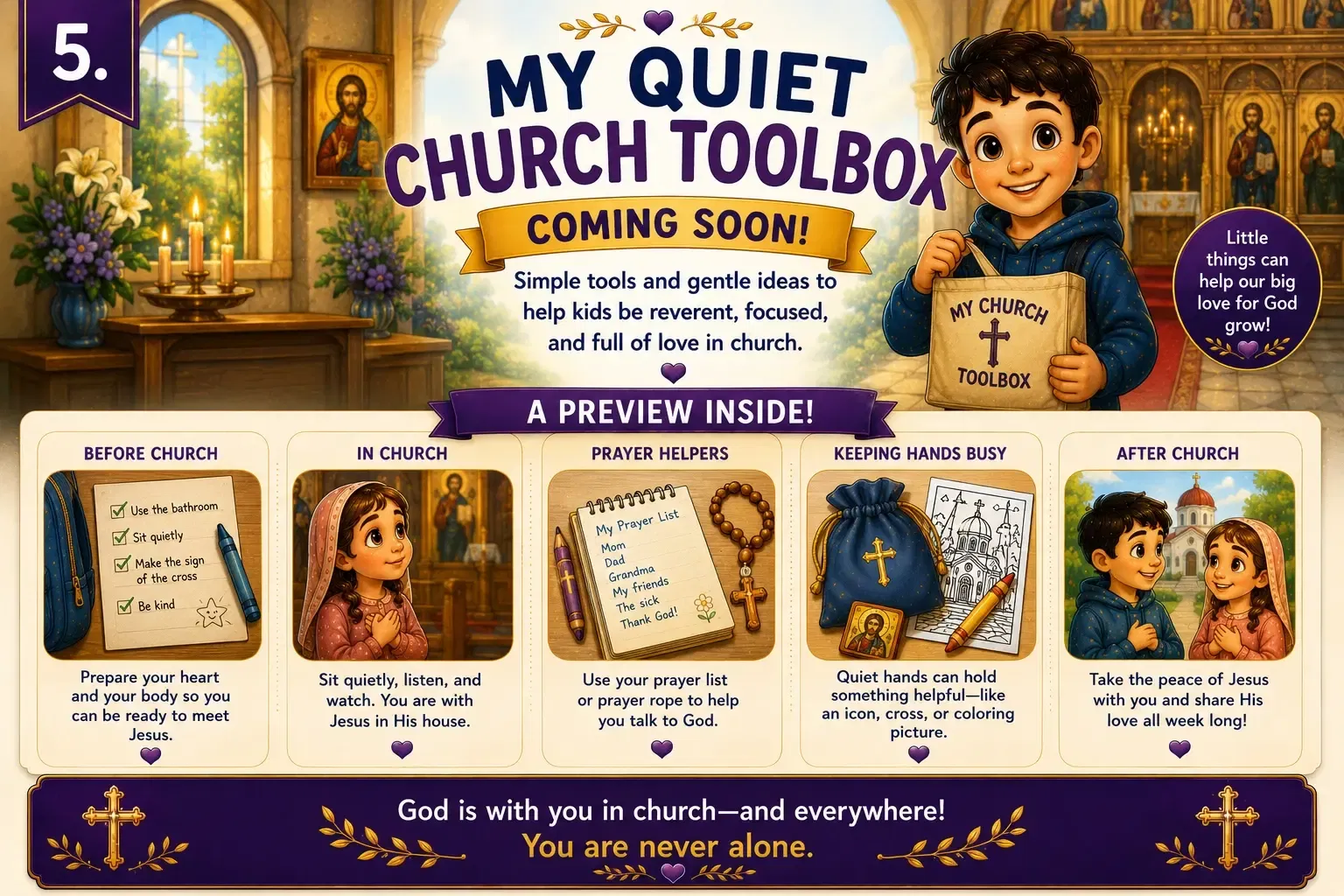
If Divine Liturgy sometimes feels loud, long, crowded, or unpredictable for your child, you are not alone. Many families are looking for gentle ways to support children with sensory sensitivities, autism, ADHD, anxiety, or communication differences during worship.
Most importantly: your child does not have to be perfectly still or perfectly quiet to belong in church. Children belong in the life of the Church as they are. A wiggle, a movement break, a quiet tool, or a brief step into the hallway does not erase their participation.
The goal is not to make a child disappear. The goal is to offer concrete support so they can connect, listen, pray, observe, move, and return in ways that are possible for them.
This quiet-church toolbox is a starting point for Orthodox Christian parenting, special needs ministry church planning, and inclusive Sunday school support. Choose only what feels helpful. Every item is an invitation, not a requirement. 💛
“Different is beautiful. Every child belongs.”
First, Let’s Change the Question 🌿
Instead of asking, “How do we make our child stay quiet for the whole service?” we can ask:
- What sounds, sights, or transitions may feel difficult?
- What helps our child feel safe and oriented?
- Where can our child participate through pointing, speaking, moving, drawing, or watching?
- What can our parish change so welcome is more than a kind word?
The Orthodox Church in America’s guidance on children and the Divine Liturgy recognizes that children need age-appropriate support, visual connection, movement, and gentle practice. It also reminds us that parish customs differ, so families should speak with their priest about local expectations.
Phase 1: Notice and Prepare Before Church 🕯️
A little preparation can soften the unknown. We can pause, breathe, and look closer at what our child may need before we walk through the doors.
1. Create a small church-only bag
Use a simple pouch or tote that comes out only for Divine Liturgy. A predictable bag can become a reassuring signal: We know what is happening next, and we have support.
Keep it light. A few useful items are better than a crowded bag.
2. Add child-sized headphones or ear defenders
Some children experience bells, chanting, crowded greetings, or echoing voices as physically uncomfortable. Child-sized headphones or ear defenders can reduce sound intensity while still allowing a child to remain connected.
Check that your child can hear important safety directions. If your parish has specific guidance about headphones, ask kindly in advance.
3. Pack one quiet fidget
Choose a silent, soft, or minimally distracting fidget: a smooth stone, fabric loop, quiet sensory ring, or small squishy item.
The purpose is not entertainment. Rhythmic hand movement may help a child listen with their whole body.
4. Bring a comfort object
A small stuffed animal, scarf, prayer cross, or familiar object can provide grounding during an unfamiliar moment.
A comfort object is not a sign that a child is too old for worship. Sometimes holding something familiar helps us feel safe enough to participate.
5. Prepare a visual guide to the Liturgy
A picture-based guide can show major moments such as:
- Gathering and opening prayers
- Little Entrance
- Scripture readings and sermon
- Great Entrance
- Creed
- Lord’s Prayer
- Communion
- Dismissal and fellowship
Your child might point to “now” or turn over one card at a time. A visual guide is a bridge to understanding, not a demand to follow every step perfectly.
6. Pre-teach bells, incense, and processions
Before Sunday, show a picture or describe what your child may notice:
- “The bells may sound suddenly.”
- “Incense may create a strong smell.”
- “People may walk in a procession.”
- “The priest may carry the Gospel or the Holy Gifts.”
- “Many people may stand, cross themselves, or bow.”
Use calm, honest language. We do not need to say, “There is nothing to worry about.” We can say, “That sound may feel big. We will be together, and you can use your headphones.”
7. Practice a gentle breathing prompt
Try a simple rhythm at home:
Breathe in for 3. Breathe out for 4.
We can quietly say, “In-2-3. Out-2-3-4.” Practice when your child is already calm, so it feels familiar when stress rises.
8. Choose a low-stimulation seating area
Consider where your child can best see and feel secure. Some children benefit from sitting near the front, where the actions are easier to observe. Others need an aisle seat, a back corner, or a place near an exit.
There is no universally correct seat. The best seat is the one that supports connection and safety.
9. Agree on a break signal
Choose a gesture, picture, or short phrase your child can use to communicate, “I need a break.”
A child may point to a break card, touch their ear, raise a hand, or whisper, “Hallway.” Communication does not have to be verbal to be meaningful.
10. Tell the priest or catechist ahead of time
A brief conversation can prevent confusion:
“Our child may use headphones, move quietly, or step out and return. We are helping them participate with support.”
This is a practical part of a special needs ministry church, not a special favor. Parish leaders can help identify a quiet room, a safe walking route, or a trusted adult.

Phase 2: Welcome Participation During Liturgy ✨
Participation can look different from child to child. One child may sing. Another may watch. Another may draw an icon, stand beside a parent, or gently move near the back.
11. Use a small drawing pad
A small drawing pad and a few crayons can give busy hands a peaceful focus. Invite your child to draw:
- The cross
- An icon
- A candle
- The church building
- Something they heard
- Someone they want to pray for
Drawing can be a form of attention. It should remain a gentle choice, not a task to complete.
12. Offer a picture prayer card
A picture prayer card might show a heart, cross, candle, family, or person in need of prayer. Your child can point to an image, trace a symbol, or hold the card during prayer.
For children who communicate without speech, this creates a meaningful way to join in.
13. Use a quiet prayer list
Invite your child to draw or write names, people who are sick, pets, friends, or things they are thankful for. A simple list can turn waiting time into loving attention.
There is no need to correct spelling or handwriting. The prayer is the offering.
14. Give one quiet object to hold
A small cross, icon card, prayer rope, or soft fabric square may help a child keep their hands grounded.
Teach gentle handling beforehand. The object should support reverence without becoming another source of pressure.
15. Point out what is happening
Use a whisper or a visual card:
- “The Gospel is being read.”
- “The choir is singing.”
- “The priest is carrying the gifts.”
- “Now we are praying together.”
Short explanations are often more helpful than long lessons. We can simply notice, pause, breathe, and listen.
16. Build in movement
Some children regulate through movement. A quiet walk near the back, standing beside a parent, stretching hands, rocking gently, or shifting from sitting to standing may help.
Movement is not automatically disrespectful. With guidance and care, it can help a child remain connected to worship.
17. Use a “focus moment” card
A visual card can show when the family will pause tools and look together. Choose only a few moments at first, such as the Gospel, Great Entrance, Creed, or Lord’s Prayer.
A child does not need to focus intensely for the entire service to have a meaningful experience.
18. Offer a calm sensory reset
If your child becomes overwhelmed, try reducing language and stimulation:
- Lower your voice.
- Move to a less crowded spot.
- Offer headphones.
- Let them hold their comfort object.
- Breathe together.
- Wait before asking questions.
Calm first. Teaching can come later.
19. Keep the toolbox flexible
What helps one Sunday may not help the next. Sleep, illness, hunger, changes in routine, weather, crowds, and unfamiliar visitors can all affect regulation.
Flexibility is not inconsistency. It is responsive care.
20. Remember that children are not required to be quiet to belong
A child may vocalize, flap, hum, sway, or need extra movement. We should distinguish between intentional disruption and a nervous system communicating a need.
Gentle support asks, “What is this behavior telling us?” before it asks, “How do we stop it?”
“We do not have to earn our place in the house of God.”
Phase 3: Plan a Dignified Exit and Return 🤍
Stepping out is not failure. Returning is not a test. Leaving briefly and coming back is participation with support.
21. Create a simple exit plan
Before Liturgy, explain:
“If the church feels too big, we will walk out together. We will find a calm place, breathe, and decide what comes next.”
Keep the route predictable. Know where the hallway, narthex, restroom, or quiet room is located.
22. Use a break card
A card might say:
I need a quiet break. I will come back when my body is ready.
The card can be shown to a parent, priest, catechist, or ministry volunteer. It gives a child a dignified communication tool without requiring a long explanation.
23. Reduce shame during the exit
Avoid announcing, scolding, or treating the break like punishment. Use neutral language:
“Your body needs less sound. We are going to take care of you.”
A calm exit protects the child’s dignity and helps the wider community remain peaceful.
24. Decide whether and when to return
After a short break, offer choices:
- “Would you like to come back now?”
- “Would you like headphones?”
- “Would you like to stand near the door?”
- “Would you like to watch from the narthex?”
- “Would you like to go home today?”
Safety and regulation come first. Returning is welcome, but it is never something to force.
25. Celebrate connection, not performance
After church, avoid asking, “Were you good?” Try:
- “What felt comfortable today?”
- “What felt too loud?”
- “What helped your body?”
- “What would you like to bring next Sunday?”
- “Did you notice anything beautiful?”
The goal is not a perfect service. The goal is a growing relationship with worship, community, and God.

How Parishes Can Make This Easier 🌟
Families should not have to solve inclusion alone. Parish leaders, priests, catechists, and volunteers can take small, ready-to-use steps:
- Create a quiet corner or calm room.
- Offer visual schedules of the Liturgy.
- Train greeters to welcome families without judgment.
- Share sensory information about bells, incense, and crowds.
- Keep a few quiet church tools available.
- Invite parents to explain what support is helpful.
- Make inclusive Sunday school flexible, visual, and choice-based.
- Welcome children who need to move, draw, point, speak, or step out.
Our parish inclusion tools are designed to help communities move from good intentions to practical support. Families may also appreciate connecting visual faith formation with our Saints and Name Days resources.
For additional Orthodox context on children and worship, read the Orthodox Church in America’s guidance on children and the Divine Liturgy. Parish practices vary, so always coordinate with your own priest or ministry leader.
A Gentle Sunday Checklist 🕊️
Before leaving home, choose only a few:
- ☐ Headphones or ear defenders
- ☐ One quiet fidget
- ☐ Comfort object
- ☐ Visual Liturgy guide
- ☐ Drawing pad and a few crayons
- ☐ Picture prayer card
- ☐ Break card
- ☐ Water or medical supports as appropriate
- ☐ A planned low-stimulation seat
- ☐ A dignified exit-and-return plan
You do not need every tool. You do not need a perfect morning. You are allowed to adjust, pause, breathe, and begin again.
Children belong in the Church, not because they can perform calmness, but because they are beloved members of the Body of Christ. With practical supports and compassionate community, Divine Liturgy can become a place where every child is invited to participate in a way that honors their body, communication, and unique gifts.
Pause. Breathe. Listen. There is room for you here. 💛

Leave a Reply