A more inclusive Sunday School does not have to begin with a new building, a large budget, or specialized equipment. Often, it begins with a handwritten picture, a welcoming face, a flexible chair, or one trusted adult who knows how to say, “You belong here.”
For Orthodox parishes welcoming children with autism, ADHD, sensory sensitivities, communication differences, or other support needs, small changes can make faith formation more predictable and accessible. These ideas use supplies your parish likely already has: bulletins, paper, crayons, pillows, baskets, icons, chairs, and willing people.
The goal is not perfect participation. The goal is belonging.
Together, we can use practical christian education resources, religious education resources, and compassionate special needs ministry church practices to make inclusive Sunday school possible this Sunday.
Begin with three gentle steps: Notice, Prepare, Welcome
Before choosing an idea, pause and consider the child’s experience.
- Notice: What might be difficult, the noise, waiting, transitions, lighting, touch, or uncertainty?
- Prepare: What simple support could make the next step clearer?
- Welcome: How can we offer choice without pressure?
Every child may participate differently from week to week. A child might listen today, draw next Sunday, and need a quiet break the week after. None of these choices is a failure.
A gentle parish does not ask, “Why can’t this child participate?” We ask, “What pathway might help this child belong?”
1. Draw a picture schedule on the back of a bulletin
Make the morning easier to understand
Use the back of an old bulletin, a sheet of scrap paper, or a small whiteboard. Draw five simple pictures showing the order of class:
Prayer → Story → Activity → Snack → Goodbye
The drawings do not need to be artistic. A heart can represent prayer. An open book can represent the story. A crayon can represent the activity.
Point to the schedule as you move through the lesson. Cross off or turn over each step when it is finished.
This simple visual cue helps children know what is happening now and what comes next. It can also support children who communicate better through pictures than spoken instructions.
Try it this Sunday: Ask one volunteer to draw the schedule before children arrive.
2. Create a pillow-and-basket quiet corner
Offer a calm place without sending anyone away
Choose a corner of the classroom and add a pillow, an empty basket, and perhaps a familiar icon or soft cloth. The space does not need to be hidden or labeled as a place for “misbehavior.” It is simply another way to participate.
The basket might hold:
- A folded bulletin
- A soft piece of fabric
- A paper and crayon
- A small book
- A quiet fidget already available in the classroom
A child may sit there for a moment, pray quietly, look at a picture, or return to the group when ready. Adults can model this by saying, “We can pause, breathe, and come back when our bodies are ready.”

If your parish is ready for additional support, our parish inclusion resources include practical guidance for quiet spaces, visual information, flexible participation, and family partnership.
A quiet corner is not an exit from community. It is a bridge back to belonging.
3. Give every child a helpful classroom job
Make belonging visible through meaningful responsibility
Children do not need to sit perfectly still to be part of the lesson. Offer a simple helper job, such as:
- Holding the picture schedule
- Passing out crayons
- Carrying the storybook
- Turning a page
- Placing an icon or picture on the table
- Collecting papers
- Choosing the closing song
Show the job with a picture or demonstrate it once. A child may accept the job, decline it, or try it for only a short time. Each response is okay.
A helper role can support movement, communication, confidence, and connection without requiring a child to speak in front of the group.
4. Use a picture-based prayer card
Make prayer accessible through seeing, pointing, and choosing
Write a short prayer on a piece of paper and add simple drawings beside key words. For example:
- A heart for love
- Hands together for pray
- A family for home
- A cross for Christ
- A sun or star for hope
Invite children to point to a picture, repeat one word, trace a symbol, or simply look at the card while the teacher prays.
You can also offer two choices: “Would you like the prayer with the heart picture or the cross picture?” Choice turns prayer into an invitation rather than a performance.
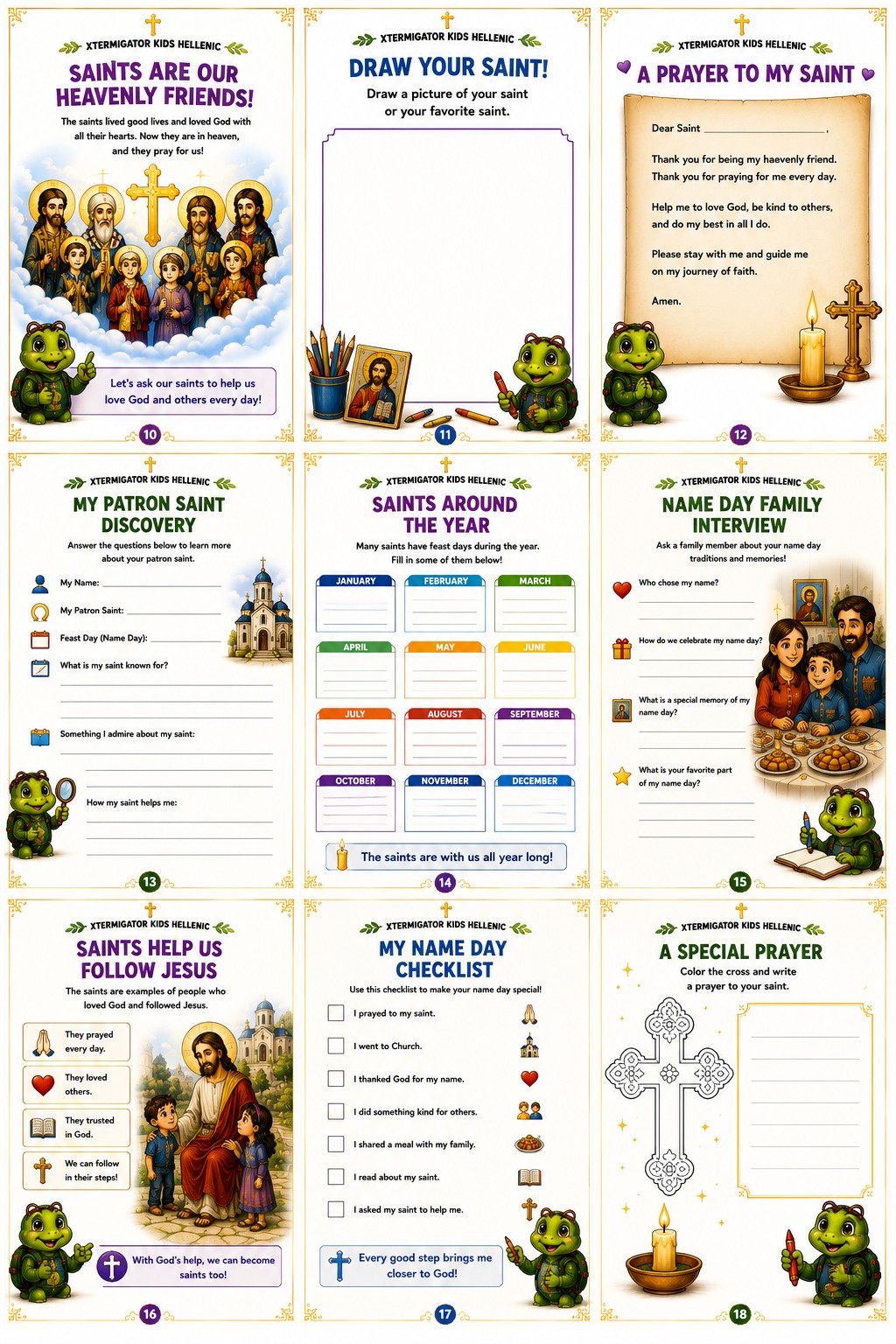
For lessons connected to saints and feast days, our Saints & Name Days resources offer visual, printable activities that children can approach by reading, listening, pointing, drawing, writing, praying, or talking with a trusted adult.
5. Make a “break” card
Give children a respectful way to communicate “I need a moment”
Cut a small rectangle from scrap paper. Write BREAK in large letters and draw a simple pause symbol or a child sitting quietly.
Explain the card to the whole class, not just to one child:
“Anyone may use this card when they need a short pause. You can show it, point to it, or ask an adult.”
Place the card where children can reach it. When a child uses it, respond calmly: “Thank you for telling me. Let’s find a comfortable place.”
A break is not a reward and does not need to be earned. It is a communication support. Children may need a break because of noise, crowded movement, strong emotions, fatigue, or difficulty processing several instructions at once.
6. Offer more than one way to respond
Let children point, draw, move, or speak
After telling a Bible story or saint’s story, avoid making spoken answers the only option. Ask children to choose how they would like to respond:
- Point to a picture
- Draw a favorite part
- Move like a character in the story
- Speak an answer
- Write a word
- Choose between two pictures
- Use a communication device or gesture
For example, after a lesson about courage, one child might say, “Brave.” Another might draw a shield. Another might point to Saint George. Another might quietly act out standing tall.
The learning is still real. The response simply looks different.
7. Plan a movement break between activities
Use purposeful movement instead of expecting long stillness
Place a one- or two-minute movement break between the story and the activity. Invite children to:
- Stretch their arms like a cross
- Walk quietly to place a picture on the wall
- Carry books to a table
- Act out a journey from a saint’s story
- Stand, breathe, and shake out their hands
- Follow a simple “reach, bend, pause” pattern
Movement can help children transition and may support attention for the next part of the lesson. It does not need to become a noisy game.
Say, “We are going to move gently, then return to our places.” Some children may participate fully, some partially, and some may watch. Watching is also a valid choice.
8. Assign a designated greeter who knows the family
Replace uncertainty with one familiar welcome
Choose one teacher, usher, or parish volunteer to serve as a consistent contact for a family. The greeter can learn:
- The child’s name and preferred communication style
- What helps during transitions
- Where the family prefers to sit
- How the child communicates “yes,” “no,” or “break”
- Who the parent wants contacted if support is needed
The greeter should never demand personal information in public. A quiet conversation with the family is enough. Families are experts on their children, and their knowledge should guide the parish’s support.
The TEAM Belong Eastern Orthodox workbook emphasizes moving beyond simple presence toward being invited, welcomed, known, supported, needed, and loved. A consistent greeter is one small way to begin that journey.
9. Walk through the church before the service
Make unfamiliar moments more predictable
Before Divine Liturgy, Sunday School, or a feast-day service, offer a brief walk-through for a child and family. Visit the places they may encounter:
- The entrance
- The classroom
- The worship space
- The restroom
- The quiet area
- The candle stand
- The location of the priest, choir, or procession
Use simple language: “This is where we enter. This is where the singing happens. The incense may smell strong here. You can step outside with your grown-up if you need to.”
A walk-through does not need to be formal. Even five calm minutes can help a child look closer, ask questions, and know what to expect.
For broader parish planning, the GOARCH Church School resources can complement your local approach to Orthodox religious education.
10. Build an inclusive lesson from ordinary supplies
Turn what you already have into a flexible faith adventure
Choose one story, icon, saint, or feast day. Then gather paper, crayons, chairs, a blanket, or a few classroom objects.
You might:
- Use chairs to create a simple path
- Use a blanket as a boat, road, or tent
- Invite children to place picture cards in story order
- Create a shared class drawing
- Let children dictate a sentence for an adult to write
- Use objects to represent people or places in the story
- End with a choice of prayer, song, drawing, or quiet reflection
Our Saints & Name Days printable collection is designed for flexible use at home, in Sunday School, or in a parish calm space. Children can explore a saint’s life through visual prompts, family traditions, prayer, and creative choices.
A simple Sunday checklist ✦
Before class begins, ask:
- Is there a picture schedule?
- Is there a place for a quiet break?
- Is one adult ready to welcome and listen?
- Can children respond in more than one way?
- Is a movement break built into the lesson?
- Does the family know what to expect?
- Have we removed pressure wherever possible?
You do not need to do everything at once. Choose one idea, notice what helps, and build from there.
Every child belongs in the story
Inclusive Sunday School is not a special program reserved for a few children. It is a way of shaping parish life so that more children can see themselves as active members of the Body of Christ.
Begin with what is already in your hands: a bulletin, a pillow, a basket, a crayon, a picture, a patient adult, and a willingness to listen.
Pause. Breathe. Welcome.
Different ways of participating can still lead us together toward prayer, learning, friendship, and Christ.

Leave a Reply