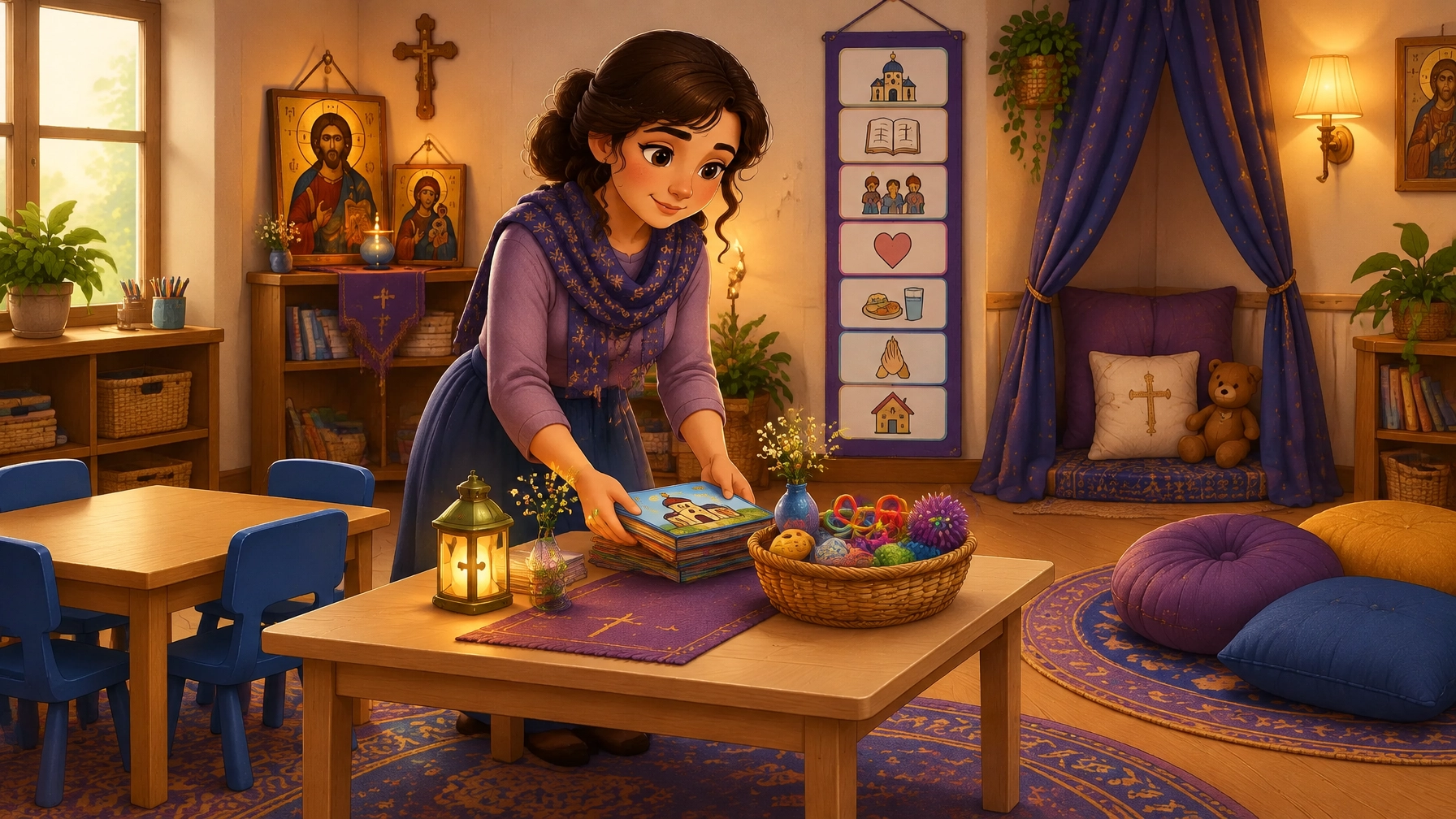
The room is almost ready. The lesson is printed, or nearly printed. Children will arrive soon.
You may have only five minutes to make your Sunday School classroom feel calmer, clearer, and more welcoming. That is enough time to make a meaningful difference.
A sensory-friendly Sunday School does not require a complete renovation, a large budget, or specialized training. It begins with small, thoughtful choices that help children know what to expect and how they may participate.
These adjustments can support autistic children, children with ADHD, children with sensory sensitivities, children who communicate differently, and any child who feels more secure when the environment is predictable.
Most importantly, sensory-friendly does not mean faith-lite. Orthodox tradition stays intact. We are simply removing unnecessary barriers so more children can listen, wonder, pray, learn, and belong.
A calmer classroom can make more room for a child’s faith, curiosity, and joy. 💛
Your five-minute welcome plan
Think of this as a quick, repeatable routine:
- Soften the room
- Create one quiet option
- Show what will happen
- Offer choices
- Welcome each child gently
You do not need to do everything perfectly. Choose the changes that are possible today, then build from there.
Minute 1: Soften harsh light and unnecessary noise 💡
Begin with the senses that children notice immediately: light and sound.
If the overhead lights are bright or buzzing, turn off some of them if possible. Use natural light, a lamp, or a softer light source instead. You can also close part of the blinds if strong sunlight creates glare.
Next, take a quick look at the room’s sound level:
- Turn off background music before class begins.
- Silence notifications on phones or tablets.
- Close a door if hallway noise is distracting.
- Avoid starting class with sudden loud sounds.
- Let children know before using music, bells, or other louder materials.
This does not mean the classroom must be silent. Many children enjoy music, singing, and movement. The goal is to make sound intentional rather than constant and surprising.
If your Sunday School curriculum includes a song or activity with louder sounds, offer a simple preview: “We will sing in a moment. You may sing, make the motions, listen, or take a quiet break.”
That one sentence gives children information and autonomy.
Pause, breathe, listen. A gentle beginning helps every child arrive. ✨
Minute 2: Designate a quiet corner 🪑
You do not need a separate sensory room to create a quiet option. Use one corner of the classroom, a space near the wall, or an area away from the busiest walkway.
Place one or two calming items there:
- A floor cushion or small chair
- A soft blanket
- A few board books
- Noise-reducing headphones
- A small stuffed animal
- A simple drawing pad
- A “break” card or picture symbol
Add a friendly sign such as:
Quiet Corner: You are welcome to rest here.
The quiet corner is not a punishment space, and it should never be presented as a place where children are sent for “bad behavior.” It is a regulation option. A child may use it for a few minutes and return when ready, or participate from there if that works better.
Keep the pathway clear so children can reach the space without climbing over bags or asking for public permission. If supervision is needed, establish a calm plan with your ministry team before class begins.
For additional parish-wide ideas, explore our parish inclusion resources for clergy, educators, and ministry teams.
A break is not a failure to participate. A break is one way a child remains connected. 🌿

Minute 3: Put up a simple visual schedule 👀
Transitions can feel difficult when children do not know what is coming next. A visual schedule makes the shape of the lesson visible.
Write or draw five or six steps on a small whiteboard, paper, or card strip:
- Welcome
- Prayer
- Bible or saint story
- Activity
- Movement or quiet choice
- Goodbye
Use pictures, objects, written words, or a combination. The schedule does not need to be beautiful. It needs to be easy to understand.
Point to each step as you move through the lesson. Before a transition, give a gentle warning:
- “Two more minutes, then we will clean up.”
- “The story is ending. The activity comes next.”
- “After prayer, you may choose drawing or building.”
If the plan changes, show the change whenever possible. You might cross out one picture, move a card, or say, “The order is different today. We will do music after the story.”
For children who do not use speech, a visual schedule can communicate without requiring an explanation. For children who do use speech, it can still reduce uncertainty and support independence.
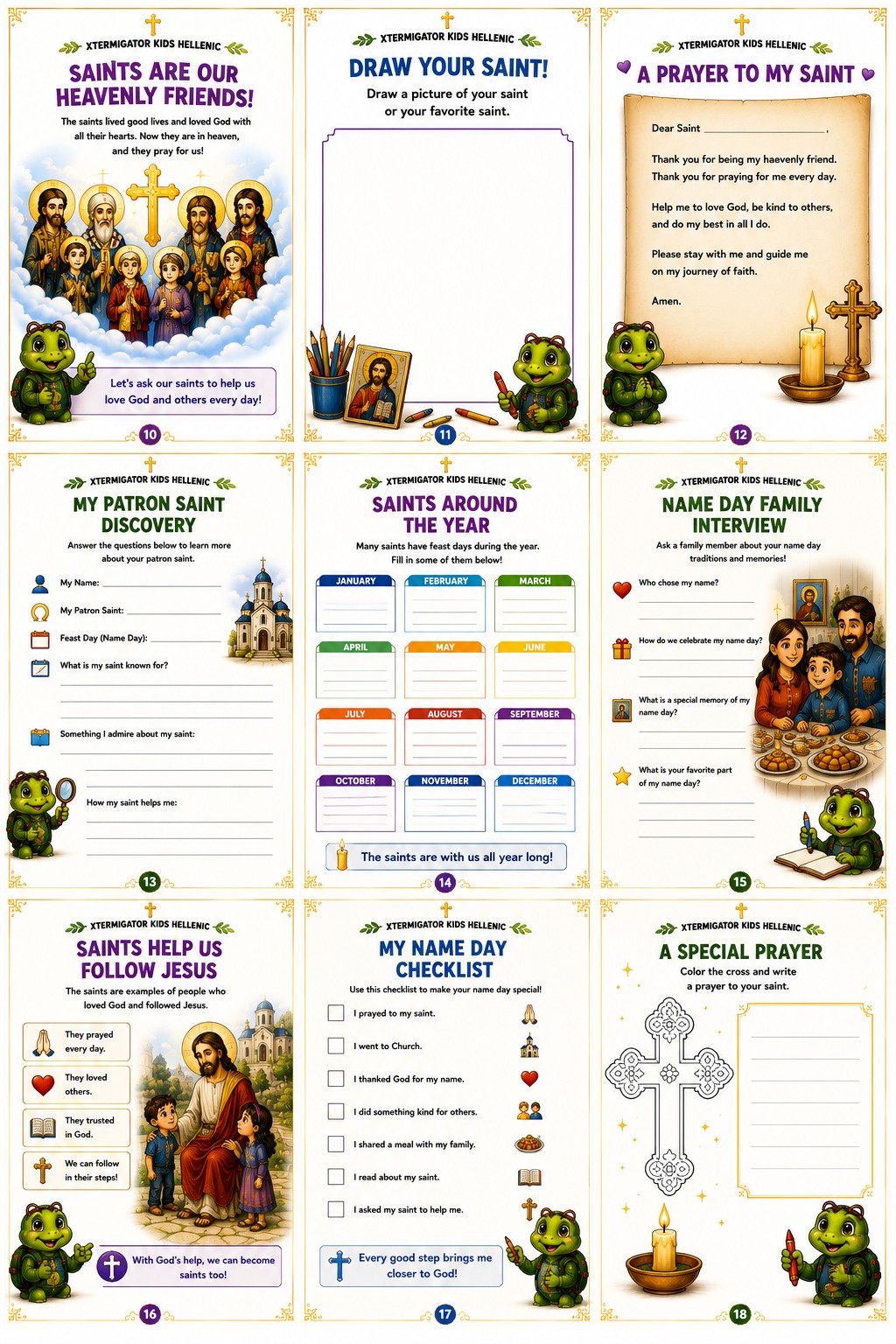
Our Saints and Name Days activities offer examples of visual, flexible faith formation that can be used at home, in Sunday School, or in a parish calm space.
Minute 4: Offer seating and participation choices 🧡
There is no single “right” way for every child to sit and learn.
Before the children arrive, make two or three seating options available:
- A regular chair
- A floor cushion
- A seat near the door
- A place at the edge of the group
- A standing space at the back
- A wiggle cushion, if your parish has one
Keep walkways open, especially toward the quiet corner and the exit. Some children focus better when they can move, stand, or sit slightly apart from the group.
You can also offer choices in how children participate:
- Point to a picture
- Repeat a phrase
- Draw an answer
- Build something
- Use a communication device
- Sign or gesture
- Listen quietly
- Speak with a trusted adult
- Watch from the quiet corner
Choice-based participation is especially helpful in an inclusive Sunday School because it communicates that children do not have to perform faith in one particular way.
A child who is listening while moving is still listening. A child who draws during the story may be deeply engaged. A child who does not answer aloud may still understand and love what they are learning.
We make space for every child to point, speak, move, draw, listen, and wonder. ⭐
Minute 5: Set out one sensory tool basket 🧺
You do not need a large collection of specialized equipment. Begin with one small basket that children may access with guidance.
Possible items include:
- Soft stress balls
- Textured fidgets
- Smooth stones
- Pipe cleaners
- Small fabric squares
- Simple coloring tools
- Ear defenders or headphones
- A visual break card
Introduce the basket to the whole class without singling out a particular child:
“These tools help some people listen and feel comfortable. You may choose one, or you may choose none.”
Set a few clear expectations:
- Tools are for helping bodies focus and feel safe.
- Tools stay quiet and do not hurt people.
- Children may return an item if it is not helpful.
- A child may request a different support or a break.
If a tool becomes distracting, redirect gently: “That item is not helping right now. Would you like to try another one or take a quiet moment?”
Whenever possible, avoid taking a sensory tool away as a punishment. The purpose is support, not compliance.

Add a calming greeting at the door 🚪
The first few seconds matter.
Instead of calling out instructions from across the room, greet each child with a calm, predictable invitation:
- “I’m glad you’re here.”
- “You can choose a seat.”
- “Here is our schedule.”
- “You may start with drawing or looking at a book.”
- “It is okay to take your time.”
Some children may want a wave. Others may prefer no touch, no eye contact, or extra physical space. Let the child’s response guide you.
A visual greeting card can help:
- Wave
- Smile
- Fist bump
- Quiet hello
- No greeting right now
The goal is not to make every child respond in the same way. The goal is to communicate: You are safe here. You belong here.
A welcoming arrival can also help caregivers feel more comfortable sharing useful information. Invite families to tell you what helps, what to notice, and how their child communicates a need for a break. Families know their children best, and partnership strengthens special needs church ministry.
Remember: small changes are real inclusion 🌟
You may not be able to change every light, purchase every sensory tool, or create a dedicated room this week. That is okay.
Start with:
- One softer light
- One quiet corner
- One visual schedule
- One seating choice
- One sensory basket
- One break card
- One compassionate greeting
These are concrete tools for real classrooms, not abstract ideals. They can be prepared before the bell, used during a busy lesson, and improved over time with feedback from children and families.
As your parish grows, you may add volunteer training, a sensory map, visual guides for the Divine Liturgy, family forms, or a parish-wide inclusion plan. Our church inclusion guide can help your team think through predictable information, flexible participation, quiet areas, and family partnership.
The Orthodox faith remains rich, beautiful, and whole. We are not removing the story, the prayer, the saints, the feast days, or the tradition. We are making more paths into them.
Different is beautiful. Every child belongs. Together, we can make welcome visible. 💛

A five-minute checklist for Sunday School teachers
Before the children arrive, ask:
- Can I soften one bright light or reduce glare?
- Is there a quiet place where a child may take a break?
- Can children see what will happen next?
- Are there at least two seating choices?
- Is one small basket of sensory tools available?
- Do children have a way to request a break without speaking?
- Can I greet each child without pressure?
You do not have to complete every box. Choose one today. Then notice what helps.
One small adjustment can become a doorway to belonging.
Leave a Reply